Pages

Showing posts with label China. Show all posts

Thursday, 18 July 2013

Obama the Hutu and Putin the Tutsi

File photo of Rwandans escaping the genocide

It is not enough for the UN to organize “funeral wakes and shed crocodile tears” for Syria at the Security Council (see yesterday’s post).
Telling us as it did, that “we have not seen a refugee outflow escalate at such a frightening rate since the Rwandan genocide,” is not helpful either.
Columnist Rajeh el-Khoury, writing today for the independent Beirut daily an-Nahar, says in part:
It is more useful for the UN to do something concrete to stop this infamy, which is worse than the massacres and genocide committed in Rwanda almost 20 years ago.
The Rwandan disaster took place in Africa’s jungles, relatively far from the world’s public eye.
But the daily massacres in Syria are being aired straightaway to every home around the globe.
Still, the Syria “Massacre’s International Department” is keen to see the pace of the killings continue unabated.
American apathy and Russian bigotry are the two faces of one and the same despicable, heinous and criminal policy.
Political solutions were foiled at the Arab League, then by a Russian veto at the UN Security Council, and since at the “Geneva Conference” farce… But the UN finds nothing better than wail the 100,000 Syrian deaths and the estimated killing of another 5,000 every month.
In Rwanda, the Hutus and Tutsis slaughtered each other as Bill Clinton stood idly by and just watched the slaughter.
Using a political metaphor, Obama represents the Hutus and Putin the Tutsis.
Both have no qualms about watching the slaughter until Syria is totally destroyed.
In the process, the largest number of Islamic extremists and jihadists would be killed alongside as many Iranians, Iraqis and Hezbollah Lebanese as possible, which would also wear down Iran.
Suspicions of a foul play on Syria also filter through this other think piece on the “Game of Nations” penned by wordsmith Samir Atallah for the Saudi daily Asharq Alawsat:
Communism collapsed in Eastern Europe in 1989, and two years later in the Soviet Union.
Some read in the two downfalls the End of History; others declared the end of the Cold War.
Russia was a bankrupt nation ruled by an addict called Boris Yeltsin while China’s economy was still predominantly rural.
But the march of history never stops and history variables are unpredictable.
The past decade saw the collapse of the U.S. economy, which was partly pulled down by the Iraq adventure.
It also witnessed the rise of China to economic giant status.
That’s when the Russians sought to take advantage of America’s enfeeblement and Europe’s fatigue and make a comeback on the international stage, using their Soviet forerunners’ wiles: the Cold War.
In a sense, the Cold War means waging hot wars away from your homeland – Vietnam, Angola, Cuba, the Balkans, the Middle East, Indonesia, Lebanon, Korea and scores of other places. That’s what the two sides do, but always covertly.
The Russians perceived in America’s exit from Iraq, her failure in Afghanistan and her financial meltdown a suitable window to recoup the role of equals in a bipolar world.
Realizing the West was shutting them out from Africa after the change in Libya, the Chinese chose to warm up to their traditionally hated partners, the Russians.
A golden opportunity came knocking with the explosion in Syria, an old Moscow lover despite her flings with the Americans in Lebanon and Iraq.
At the UN Security Council, the Russians pulled their veto sword from its sheath in anticipation of a duel.
They were surprised to find a bystander instead of an adversary. They found Obama playing the old Soviet role -- passionate verbosity and hot air.
In this crisscross painting of the battle scene, Putin visited America’s two principal military allies in the region, Israel and Turkey.
People who expected Obama to change tack in his second term saw him replace Hillary Clinton with John Kerry.
American ambulation and cogitation supplanted the ragged Russian footwork.
In the tug-of-war, nuclear Iran played the role of nuclear Cuba with cold, limited and timid Russian backing and American cautioning.
While the Russians and Americans weighed their moves, and China pondered the words of her Security Council representative, 100,000 Syrians were killed and 10 million displaced.
The quintessence of the conflict changed from Hama to Qusayr, the MiGs destroyed a quarter of Syria, the Middle East toppled over and the ultimate peril of sectarian conflict ignited.
The Big Powers don’t change. Everything outside their borders is a “game.”

Tuesday, 16 July 2013

“Greater Syria: From Dagestan to Xinjiang”


Al-Qaeda offshoots are set to declare an Islamist state in Syria’s north on Eid al-Fitr (August 8), according to Saudi Arabia’s leading daily Asharq Alawsat quoting a Free Syrian Army (FSA) top dog.
The paper quotes him saying the al-Qaeda-linked groups hope by then to have wrested control from the FSA of the two border crossings into Turkey: Bab al-Hawa and Harem.
Bab al-Hawa links Turkish and Syrian highways between the cities of Iskenderun and Aleppo. The closest town to Bab al-Hawa on the Turkish side of the border is Reyhanli in Hatay province, and the nearest town on the Syrian side is al-Dana.
Harem is right by the Turkish frontier in Syria’s northern Idlib Province.
The FSA official speaking to Asharq Alawsat linked plans to declare an Islamic state in Syria’s north to recent killings by the Islamic State of Iraq and the Levant of two senior FSA officers – namely, Fadi al-Qish, a local FSA commander in the village of al-Dana and Kamal Hamami (aka Abu Baseer al-Ladkani), member of the FSA Supreme Military Council.
Asharq Alawsat’s FSA source said the FSA was deploying units and checkpoints in areas targeted by the Islamic State of Iraq and the Levant to prevent them falling into its fighters’ hands.
Tariq Alhomayed, Asharq Alawsat’s former editor-in-chief, writes in his daily column for the newspaper:
Irrespective of the accuracy of reports about armed clashes between al-Qaeda and the FSA, and the attempt to assassinate the latter’s overall commander Gen. Salim Idriss, this is what is in the cards, whether now or later on.
The confrontation between al-Qaeda and the Syrians is inevitable because al-Qaeda is the fleeting anomaly while Syrian moderation is the established rule.
The danger in the Syrian scene today is that the FSA is now facing Bashar al-Assad’s regime, fighters from Iran, (Lebanese) Hezbollah and Iraqi Shiite militias, and al-Qaeda...
The irony is that the FSA is still being deprived of qualitative arms and left to face this array of forces singlehanded.
Gen. Idriss has accused David Cameron of betrayal after the British Prime Minister abandoned plans to arm the Syrian opposition.
He said the decision would "leave us alone to be killed" by Assad, and pave the way for al-Qaeda to dominate rebel ranks.
Gen. Idriss hit out in an interview with The Daily Telegraph after Downing Street confirmed Cameron had ruled out arming the opposition on advise from the British military. The government had previously hinted that it was strongly considering it, successfully lobbying two months ago for an end to the European Union arms embargo.
But military chiefs at Britain's National Security Council are understood to have warned Downing Street the conflict was now too advanced for basic weapons supplies to make much difference.
They said that could only be achieved by a much-larger scale intervention, involving jet strikes on regime air defenses and bases, which Britain has already ruled out.
Instead, Britain will draw up plans to train moderate rebel units and continue supplying "non-lethal" items like body armor and communications equipment.
Idriss greeted the British change of heart with fury. The FSA has spent much of the last two years trying to persuade the West to give it military backing.
"The West promises and promises. This is a joke now," Idriss said, the anger clear in his voice. "I have not had the opportunity to ask David Cameron personally if he will leave us alone to be killed. On behalf of all the Syrians, thank you very much."
"What are our friends in the West waiting for?" asked Idriss. "For Iran and Hezbollah to kill all the Syrian people?"
He also warned the West’s refusal to arm the more moderate elements of the insurgency would hand Syria's revolution to extremist groups, who already have better access to weapons.
"Soon there will be no FSA to arm," he said. "The Islamic groups will take control of everything, and this is not in the interests of Britain."
The British refusal will be seen as a particular blow to rebel morale given that recent signals suggested the government was planning the very opposite tack.
Only last month, William Hague, the Foreign Secretary, insisted Britain "shouldn't rule any option out," claiming that concerns about arms earmarked for secular rebel groups falling into jihadist hands were exaggerated.
Greater Syria: From Dagestan to Xinjiang” is the title of a related and enlightening think piece by veteran Lebanese political analyst Jihad el-Zein for today’s edition of the Beirut daily an-Nahar.
The gist of Zein’s opinion:
The Syria crisis is into a third “jihadist” phase, having already gone through “civil” then “militarized” chapters.
The “jihadist” phase currently underway elicits greater commitment by Russia and China because it touches on their home front concerns.
Earlier this month, for instance, Chinese state media blamed Syrians for unrest in Xinjiang, which is home to the minority Muslim Uighur population.
China has traditionally blamed violence in Xinjiang on Islamic separatists who want to establish an independent state of “East Turkestan.”
This time Beijing laid the blame squarely on terrorists in Syria, of which the al-Qaeda-affiliated al-Nusra Front is the most notorious, but the charge of a Syria connection still comports with a common government narrative of portraying Xinjiang’s violence as coming from other countries, such as Pakistan and Afghanistan, rather than homegrown agitation.
While about 90 per cent of China is ethnic Han, more than 40 per cent of Xinjiang’s 22 million people are Uighurs.
The Global Times, a tabloid owned by the Communist Party mouthpiece, the People's Daily, said some members of the East Turkestan faction had moved from Turkey into Syria.
The rise of Salafist militancy in Syrian rebel groups is a tremendous concern for Russia too.
Moscow fears the numbers and efficacy of forces such as al-Nusra Front will one day turn their attention to oppressed Muslim regions in Russia such as Dagestan and Chechnya.
Dagestan, the region where the brothers who bombed this year's Boston Marathon once lived, borders on the Caspian Sea, Azerbaijan, Chechnya and Georgia.
President Vladimir Putin has dismissed the leader of Dagestan, where an Islamist insurgency is raging. The region has taken over from neighboring Chechnya as Russia's most volatile province.
Salafist fighters, including some from al-Qaeda, fought in Chechnya in the 1990s; they may do so again. Syria and Chechnya are only five hundred miles apart.
If you looked at a map of Russia, you would see Dagestan’s seaports on the Caspian Sea can easily ferry arms and everything else to neighboring Iran and from there across the “Shiite Crescent” to Syria via Iraq.
The struggle for Syria is thus strategic, not tactical, for Russia and less so China. Both have a bigger stake now in the “jihadist” chapter of the Syria crisis as it impacts their respective home fronts.
That’s why the “Greater Syria” – i.e. an international and regional struggle with the following coordinates:
-- Longitude from Dagestan to Xinjiang via Peshawar, covering the Jihadist stretch
-- Latitude from South Lebanon’s Naqoura to Tehran, taking in the Shiite spread.

Friday, 3 May 2013

When Syria’s WMD facts clash with U.S. policy


“The U.S.-led international community is looking for ways to coexist with the common usage of chemical weapons in Syria. It does not want to face facts and punish the user of chemicals, which are banned genocide weapons after all.”
Also, Lebanese author and political analyst Abdelwahhab Badrakhan writes today in his weekly column for pan-Arab al-Hayat, can anyone recall any international outcry against the shelling of civilian areas with ballistic missiles, such as Scuds, which are classified as weapons of mass destruction (WMDs)?
“Of course not -- the world powers gulped down the missiles and are allowing them as a matter of routine.
“You had an American president who fabricated lies about WMDs to invade Iraq. His successor is now belying facts about them to avoid protecting a populace against the barbarity of its regime.”
Badrakhan continues:
When Barack Obama said the use of chemical weapons was a “red line,” he was paving the way for legitimate international intervention, unlike the intervention by Iran and Hezbollah. His ceaseless dithering since will likely squander the inferred legitimacy.
“You also have a stone-deaf Russian president who decided to recoup the glories of a now-defunct superpower at the expense of Syrian corpses. Having grown up despising his people, he does not give a hoot about other peoples and their aspirations. He remains a longtime ally of a ruler duplicating, if not surpassing, his abuses in Chechnya.
Both Russia and China perceive the Syrian regime as fighting a proxy war on their behalf to show that defeating the people’s will is possible and to prove that rulers are more durable because they have the muscle.”
When he talked his fill on the Syria war to a deputation of Lebanese loyalists on April 21, Assad said, “Russia considers the battle to defend Damascus as a battle to defend the status and interests of Moscow.” He also said, “Americans in the end go along with the winner” – meaning him.
But Assad is not the winner of the Syria war as yet. It’s a war he can’t possibly win, even if he confined it to Damascus, which he is trying to do by surrounding it with a ring of fire.
Assad is meantime pressing the Russians and Iranians to help him tip the military balance in his favor in the countdown to the Obama-Putin meeting on the sidelines of the G8 summit in Northern Ireland in June.
He already told his visiting group of Lebanese loyalists, “We need to impose our rhythm on the summit instead of vice versa. Each of the two presidents will be looking at the facts on the ground in Syria to determine what he does.”
What Assad knows all too well, but did not spell out, is that the arming of opposition forces and the Free Syrian Army has been retrogressing since at least mid-April, presumably because of Jabhat al-Nusra.
Putin and Assad are hedging their bets on the outcome of the battle for Damascus and on Obama remaining “pragmatic” and acknowledging the regime’s strength and steadfastness.
In this case, the U.S. president would choose either (1) to throw his weight behind opposition forces to even the power balance, or (2) to go along with a political solution under regime auspices.
If Obama were to choose the second option, Washington won’t be able to impose it on either the offshore Syrian Opposition Coalition or its onshore counterpart.
Neither can go along with a political solution that repackages the regime without its war crimes, without its crimes against humanity, without its displacement of its people and its destruction of their homes, and without its dabbling with genocide policies.
Even if America cowed both the offshore and onshore oppositions by giving them the hard sell, they cannot deliver the fighters on the ground.
The armed insurgents’ sacrifices were not meant to win them ministerial portfolios and the grace of becoming regime partners.  

Monday, 15 April 2013

D-Day over Syria chemicals is set for June


Abdelbari Atwan, publisher and editor-in-chief of the London-based pan-Arab daily al-Quds al-Arabi, today says he hears through the grapevine that the die is cast for a Syria war finale in June.
He elaborates:
My unimpeachable Arab sources suggest the United States has already passed on the information -- which was understandably short on details -- to trusted regional allies.
What gives credence to their anticipation is this:
1. The majority of the Arab region’s wars and invasions took place in the summer months, mostly June. They include the 1948 War, the 1967 Six-Day War, the 1982 Invasion of Lebanon, the 2006 Lebanon War and the 1990 Invasion of Kuwait. The revolutions of 1952 in Egypt and 1958 in Iraq also took place in the summer month of July.
2. Last week’s report in The Times of London that a soil sample taken out from a neighborhood on the outskirts of Damascus, and smuggled out of Syria in a secret British operation, appeared to provide the first forensic evidence of chemical weapons being used in the ongoing fighting. The sample could not indicate whether regime forces or rebel fighters fired the chemical.
3. A report by CNN last week saying that under pressure from Democrats and Republicans, the Joint Staff of the Pentagon and the U.S. Central Command have updated potential military options for intervention in Syria.
4. Reports that the intensive training in Turkey and Jordan of small, CIA-vetted groups of FSA fighters by special American and British forces will conclude around mid-May.
5. The European Union’s embargo on the shipment of arms to Syria will expire end-May, allowing Britain and France to supply antiaircraft and antitank weapons to Syrian opposition forces.
6. The impasse over terms of the UN deploying a chemical weapons inspection team in Syria. Damascus has asked for the UN team to investigate what it says was a poison attack by rebels in Aleppo’s Khan al-Assal last month. But Damascus has rejected demands by the opposition that the inspectors also be sent to investigate other locations where rebels say government forces used chemical munitions.
The leak about British Ministry of Defense scientists establishing conclusive proof that chemical munitions are used in Syria was not meant to ascertain freedom of expression or The Times’ credentials. It was meant to serve another purpose, which we know little about for the moment.
But the disclosure does evoke the story of Farzad Bazoft, the Iranian-born British journalist who was sent to Baghdad in 1989 to fetch a soil sample from near a nonconventional weapons complex. Months after the incident, Iraq was isolated – and the rest is history.
Some six months ago, U.S. President Barack Obama started warning that Syria’s use of chemical weapons would cross a red line and could change his calculus about intervention.
Last week, foreign ministers from the G8 nations ended a two-day meeting in London echoing his repeated warnings since. They reaffirmed in their closing statement their view that “any use of chemical weapons would demand a serious international response.”
Significantly, Syrian opposition leaders Moaz al-Khatib and Ghassan Hitto met with several of the G8 ministers on the sidelines of the London talks.
This shows we’re inching closer to the scenario of the Iraq invasion coming in the wake of the Iraq sanctions and embargo.
The Iraq scenario kicked off with the March 1988 use of poison gas against the Kurdish town of Halabja that killed 5,000 people.
The Homs neighborhood of al-Bayyada could well become Syria’s Halabja and Bashar al-Assad could in turn become the new Saddam Hussein.
The evidence-gathering process is gaining pace in Syria to justify and legitimize military action that seems imminent.
The pressing question is: Will the military action start with no-fly zones and the qualitative arming of the opposition in order to induce a bigger involvement by Iran? Or will it start in the framework of a joint American-Israeli-Arab war against Iran and Syria together?
Iran is in the frame because Israel believes the Islamic Republic will have the bomb by year’s end.
The big difference between the Iraq and Syria scenarios is that when it faced the embargo, the Saddam regime stood alone. Mikhail Gorbachev’s Russia was broke and in a state of transition and China was building up it economic muscle.
In contrast, Iran, Hezbollah and Russia and its four BRICS partners – namely, China India, Brazil and South Africa – are standing behind the Assad regime.
Ironically, the hot summer month of June comes this year some 40 days ahead Ramadan. I won’t be surprised if it turned out to be the most incendiary in the Arabs’ history.

Wednesday, 10 April 2013

Civilian deaths from Syria’s skies, says HRW


Syrian President Bashar al-Assad’s warplanes specifically “target civilians,” according to a Human Rights Watch citing “compelling evidence that the Syrian government is committing crimes against humanity.” The watchdog publicized the report in this press release:
(Aleppo) – The Syrian Air Force has repeatedly carried out indiscriminate, and in some cases deliberate, air strikes against civilians. These attacks are serious violations of international humanitarian law (the laws of war), and people who commit such violations with criminal intent are responsible for war crimes.
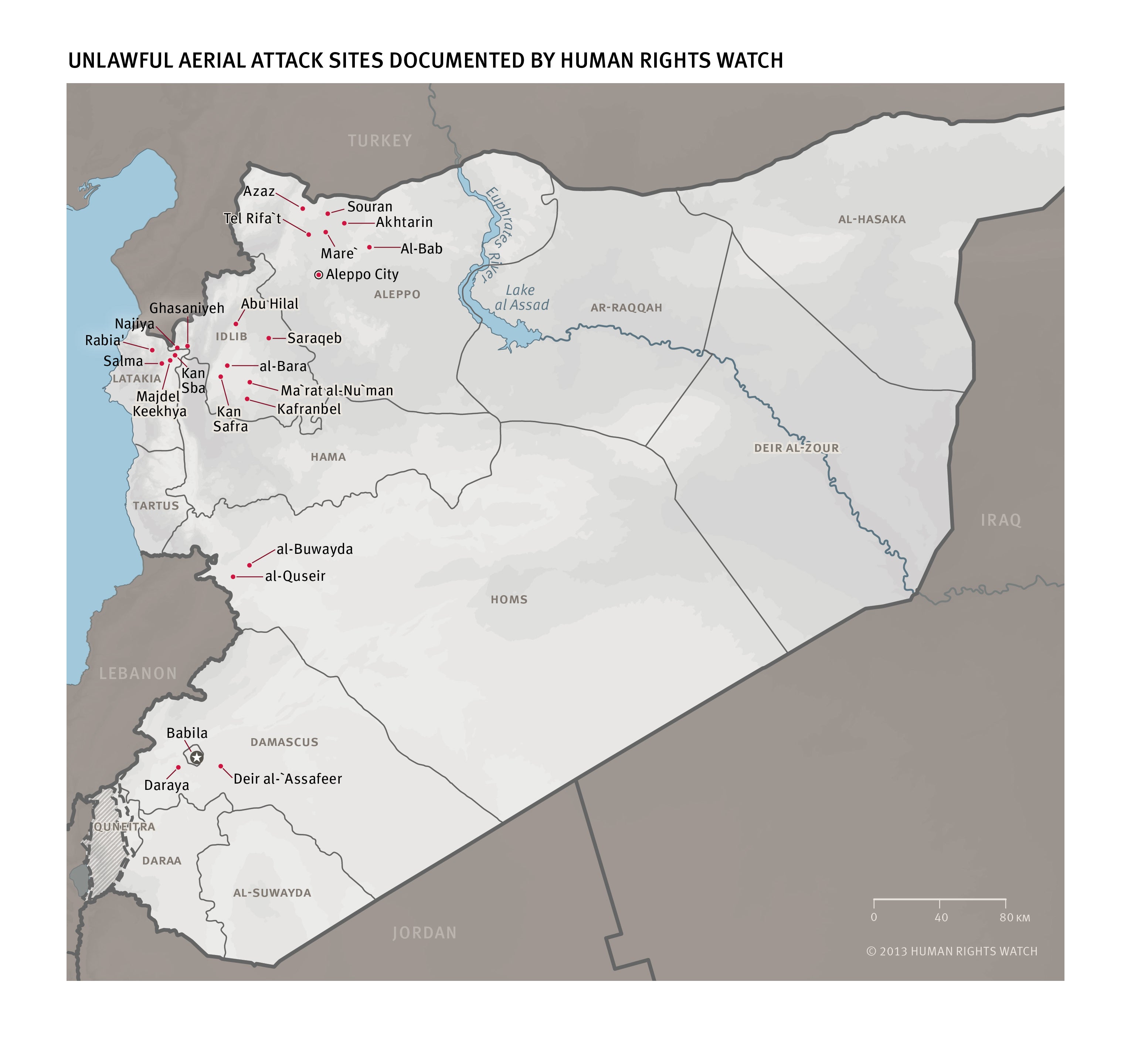
The 80-page report, “Death from the Skies: Deliberate and Indiscriminate Air Strikes on Civilians,” is based on visits to 50 sites of government air strikes in opposition-controlled areas in Aleppo, Idlib, and Latakia governorates, and more than 140 interviews with witnesses and victims.
The air strikes Human Rights Watch documented killed at least 152 civilians. According to a network of local Syrian activists, air strikes have killed more than 4,300 civilians across Syria since July 2012.
“In village after village, we found a civilian population terrified by their country’s own air force,” said Ole Solvang, a Human Rights Watch emergencies researcher who visited the sites and interviewed many of the victims and witnesses. “These illegal air strikes killed and injured many civilians and sowed a path of destruction, fear, and displacement.”
Media reports, YouTube videos, and information from opposition activists show that the Syrian government has conducted air strikes all over Syria on a daily basis since July 2012.
Through the on-site investigations and interviews, Human Rights Watch gathered information that indicates government forces deliberately targeted four bakeries where civilians were waiting in breadlines a total of eight times, and hit other bakeries with artillery attacks.
Repeated aerial attacks on two hospitals in the areas Human Rights Watch visited strongly suggest the government also deliberately targeted these facilities. At the time of Human Rights Watch’s visits to the two hospitals they had been attacked a total of seven times.
In addition to the attacks on the bakeries and hospitals, Human Rights Watch concluded in 44 other cases that air strikes were unlawful under the laws of war. Syrian forces used means and methods of warfare, such as unguided bombs dropped by high-flying helicopters, that under the circumstances could not distinguish between civilians and combatants, and thus were indiscriminate.

In the strikes Human Rights Watch investigated, despite high civilian casualties, damage to opposition headquarters and other possible military structures was minimal.
As far as Human Rights Watch could establish, there were no casualties among opposition fighters.
For example, a jet dropped two bombs on the town of Akhtarin in northern Aleppo at around 1 p.m. on November 7, 2012, destroying three houses and killing seven civilians, including five children. The strike injured another five children, all under five.  Human Rights Watch identified a possible military target in the vicinity, a building about 50 meters away that was used by opposition fighters at the time. This building was only lightly damaged in a subsequent attack, however. 

A neighbor who rushed to the site after the attack told a Human Rights Watch researcher who visited the area:
It was tragic. The buildings had turned into a heap of rubble. We started pulling people out using just our hands and shovels. A cupboard and a wall had fallen on the children. They were still alive when we found them, but they died before we could take them to their uncle’s house. There is no clinic or medical center here.
In addition to the attacks on bakeries and hospitals, some attacks documented by Human Rights Watch, particularly those in which there was no evidence of a valid military target in the vicinity, may have deliberately targeted civilians, but more information is needed to reach that conclusion, Human Rights Watch said.

The government’s use of unlawful means of attack has also included cluster munitions, weapons that have been banned by most nations because of their indiscriminate nature. Human Rights Watch has documented government use of more than 150 cluster bombs in 119 locations since October 2012.
Human Rights Watch also documented that the government used incendiary weapons, which should, at a minimum, be banned in populated areas.
The obligation to minimize harm to the civilian population applies to all parties to a conflict. The Free Syrian Army (FSA) and other Syrian armed opposition groups did not take all feasible measures to avoid deploying forces and structures such as headquarters in or near densely populated areas. However, an attacking party is not relieved from the obligation to take into account the risk to civilians from an attack on the grounds that the defending party has located military targets within or near populated areas.
Human Rights Watch was able to visit only sites in opposition-controlled areas in northern Syria because the government has denied Human Rights Watch access to the rest of the country. While further investigation is needed, interviews with witnesses and victims of air strikes in other parts of the country indicate that a similar pattern of unlawful attacks have taken place there.
Human Rights Watch believes this report should galvanize international efforts to end deliberate, indiscriminate, and disproportionate air strikes and other attacks on civilians, including all use of cluster munitions, ballistic missiles, incendiary weapons, and explosive weapons with wide-area effects in populated areas.
The information we have gathered should also assist those seeking to bring the perpetrators of these crimes to justice.


Given compelling evidence that the Syrian government is committing crimes against humanity, Human Rights Watch calls on governments and companies to immediately stop selling or supplying weapons, ammunition, and material to Syria until Syria stops committing these crimes.
The international community should in particular press Iraq to verify that no arms from Russia or Iran for Syria are passing through its territory, and to that end allow independent, third-party monitors to inspect convoys and airplanes crossing Iraqi land or airspace and bound for Syria.


“The Security Council, largely due to the Russian and Chinese veto, has failed to take any meaningful steps to help protect civilians in Syria,” Solvang said. “But that should not stop concerned governments from stepping up their own efforts to press the Syrian government to end these violations.”

Sunday, 17 February 2013

A propos Iran, the U.S. and Saudi foreign policy

U.S. and Iran footballers: A lesson for politicians?

Saudi foreign policy has to grapple with two key problems à propos change in the region and the world order.
One is Iran, which is not exactly a new problem. The other is the Obama Administration forging ahead with its strategic pivot from the Middle East to East Asia.
Saudi academician and writer Khalid al-Dakheel, in his weekly column today for the Saudi-owned pan-Arab daily al-Hayat, believes the two problems have taken new dimensions.
He explains:
After gaining a foothold in Bilad al-Sham through its alliance with the Syrian regime, Iran proceeded to plant Hezbollah as its military arm in Lebanon.
Ironically, this was done under the smokescreen of “resistance” (to Israel) and a Saudi-Syrian “understanding” on Lebanon.
Having then bagged Iraq from U.S. occupation forces and enthroned its surrogates in Baghdad, Iran is now out defending the Syrian regime and striving to be the paramount power in the Gulf as a step to expand its influence throughout the Arab Mashreq.
Iran’s aim is to be the nation-state of the region’s Shiites and to be recognized as such by Washington.
To realize this dream, after ensnaring Syria and Iraq, Iran has to face the bigger challenge posed by Saudi Arabia and Egypt – more so Saudi Arabia because it is the Gulf’s richest country, sits on Iraq’s doorstep and is home to Islam’s two holiest mosques (al-Masjid al-Haram in Mecca and al-Masjid al-Nabawi in Medina).
Iran is aware that undermining Saudi Arabia is a tall order: the ethnic, sectarian and historical impediments are simply formidable and countless. That’s why Tehran chose instead to surround the kingdom with Iranian clients and hotbeds of unrest – northward in Iraq, southward in Yemen and eastward in Bahrain and Kuwait.
Egypt is as impregnable as Saudi Arabia, except that Egypt lies further away geographically and is currently beset with political and economic problems. This explains why Iran is trying to lure Egypt away from the Gulf with promises of financial aid and a collaborative solution for Syria.
With the Syrian regime now on its last legs, Iran can recognize the expiry of its sell by date, cut its losses and facilitate the transfer of power in Damascus. Or, it can continue backing the regime at the price of walking away with no more than a piece of a fragmented Syria.
Iran’s predicament is also the region’s. Therein lies the future significance of Saudi foreign policy and Washington’s pivoting from the Middle East to the Asia-Pacific region.
President Barack Obama’s pivot toward the Asia-Pacific region is all about China.
While the U.S. was off fighting its wars in Afghanistan and Iraq, China’s amazing growth and the promise of its huge and expanding market turned the Asia-Pacific region into the global economy’s center of gravity.
A report last November by the Organization for Economic Cooperation and Development (OECD) expects the United States to cede its place as the world’s largest economy to China as early as 2016.
Washington is equally concerned by China more than doubling its declared military spending from 2006 to 2012, roughly in keeping with economic growth.
There are two unmistakable signs Obama is forging ahead with steps to pivot U.S. foreign policy from the Middle East to Asia.
One is his perseverance in “leading from behind” on Syria. The other is keeping his “extended hand” to Iran.
Zbigniew Brzezinski, who served as U.S. National Security Advisor under President Jimmy Carter, says the U.S. can deter and contain a nuclear Iran, such as it is still deterring North Korea from using its nuclear weapons against South Korea and Japan.
Also, confirmation of Chuck Hagel, Obama’s pick for defense secretary, remains blocked because he is soft on Iran and previously called for talks between Washington and Tehran without preconditions.
It seems America’s strategic shift to Southeast Asia, the accumulation of Arab crises and the Arab’s impotence in solving albeit one of them are pushing many Americans to support a political deal with Iran.
Strangely, all U.S. talk of such an understanding with Tehran makes no mention of Saudi Arabia.
So how would Saudi Arabia react? Could it face such an eventuality with its same old foreign policy tools and premises?
Saudi foreign policy needs to update its perceptions and tools to match up with America’s strategic rebalancing, Iran’s agenda and the current winds thrashing the Arab world, not to mention the sea changes in Saudi society, the region and the world order.
Can the foreign policy adopted at the height of the Cold War by King Saud and King Faisal, God bless their souls, remain unchanged after 50 years?
Clearly, the policy that failed in Iraq and Syria, was half-successful in Yemen and Bahrain and missed setting up stable and enduring alliances in the region needs reappraisal and revision.

Saturday, 19 January 2013

Are Turks in Somalia for the hajj or to sell beads?


Jamal Khashoggi, the Saudi journalist and author now heading Al Arab News Channel, penned this think piece in Arabic for today’s al-Hayat
Erdogan and his wife Emine in Somalia in August 2011 
Next to us, we Saudis, and within our strategic security sphere, lies a country biting the dust for more than two decades.
Its collapse began when its last “effective” government, which was neither successful nor popularly elected, fell.
Even if that government had survived to this day, it surely would have been swept away by the Arab Spring.
Together with our neighbors in the region, we looked after it on one or two occasions, and then moved away.
Even the Americans ran out on it after a solitary attempt to save it in the wake of the war to liberate Kuwait. At the time, George Bush Sr. may have wanted to show his country was also ready to intervene and help a poverty-stricken Muslim country, unlike oil-rich Kuwait. It turned out to be a bitter American experience.
I am referring to Somalia.
Who wants to help Somalia? Its people are unruly, plagued by differences and internecine strife, and ruled by warlords. Al-Qaeda infested many of its citizens’ minds, adding to miseries and divisions even in single households.
In the end, Somalia became the hotbed of high sea piracy. The world came to shun both the state and its people. Somalis got to be a source of concern for Saudi Arabia and its Gulf partners after a rise in their illegal immigration across Yemen through a transnational network of organized crime in the smuggling of migrants.
Everyone lost hope in Somalia and no one believed the failed state would recover anytime soon.
Or so it seemed.
There is now a glimmer of hope looming on the horizon.
International organizations now say Somalia is on the mend. Its markets are beginning to recover, together with trade and construction activities. People who visited Somalia of late say there is money moving around in the impoverished country.
So, what happened?
The answer is Turkey and its Prime Minister Recep Tayyip Erdogan, who is now the most popular leader there, with Somali mothers and fathers eager to name their newborns “Recep,” “Tayyip” and “Erdogan.”
So what is Turkey doing in Somalia and why? Is it on “a pilgrimage or selling beads” there -- which is a common expression used by Mecca residents well grounded in combining godliness and moneymaking?
One school of thought worth monitoring is known as “Turkey’s moderate Islam,” which combines advocacy with spreading the teachings of religion, economic development and trade.
It is capitalized on by dynamic Turkish businesses in carving out new markets.
There is a Turkish scholar, author and educator named Fethullah Gülen, who founded the Gülen movement that is believed to have 1,000 schools around the world and more than 10 million followers in Turkey alone. He currently lives in self-exile in Pennsylvania.
I was in Turkey some 25 years ago, trying to cover the rise of political Islam, when I first heard his name. But I didn’t get to meet him as he always shunned publicity and the media.
He had left Turkey for the United States when he was committed for trial in 2000 after the leaking of a video urging his followers to “move within the arteries of the system, without anyone noticing your existence, until you reach all the power centers. You must wait until such time as you have got all the state power.”
Originally charged with trying to undermine the secularity of the Turkish state, Gülen was acquitted in 2008 but continues to live in seclusion in Pennsylvania.
The Gülen movement is operating in Somalia through aid relief and development agencies, offering young Somali men and women scholarships for religious studies in Turkey. They would eventually replace Somali graduates of hard-line religious schools funded by Gulf charities.
By the time he flew to Somalia in August 2011, Erdogan had arranged for more than 1,200 Somali students to arrive in Turkey on full scholarship to study sciences, engineering, medicine and law at a cost of $70 million.
He then raised from Turkey’s private sector more than $365 in donations to Somalia, over and above his government’s $49 million contribution.
Today, Turkish traders and aid workers move freely across Somalia without needing to worry about being killed or kidnapped.
In contrast, UN and international aid workers remain holed up in their Somali offices or hotel rooms.
Is this happening because Turks, being Muslims, are familiar with the Somali people’s character and norms?
Julia Harte raises the question in her recent article, “Turkey Shocks Africa,” on which I relied to pen this think piece and which I strongly urge you to read.
Or does Turkey have a comprehensive plan – denied by the government – to marry advocacy and trade, thus help Turkish entrepreneurs and businesses gain favor among Somalis?
Or is energy-starved Turkey eyeing opportunities offered by the prospective find of 10 billion barrels of crude oil in Somalia’s northeastern Puntland province?
Alternatively, is Turkey mounting a smart charm offensive to increase its overall exports to Africa, which rose to $10.3 billion last year from $2.1 billion in 2003?
Turkey is now challenging China on African markets, but with a more humane face than the alienating method favored by the Chinese.
Regardless of Turkey’s motives, what happened benefited both the Turks and the Somalis.
And what about us?
It’s wrong to portray the Turks as competitors. They are friends who did what we should have done. It’s therefore good to catch up with them and participate in this benefaction. After all, we spearheaded the concept, “The Hajj…and the sale of beads.”