Pages

Thursday, 21 March 2013

Six reasons why Syria’s rebellion is into Year 3


“With respect to Syria,” President Barack Obama said yesterday at his joint press conference with Israeli Prime Minister Benjamin Netanyahu in Jerusalem, “the United States continues to work with allies and friends and the Syrian opposition to hasten the end of Assad’s rule, to stop the violence against the Syrian people, and begin the transition towards a new government that respects the rights of all its people. Assad has lost his legitimacy to lead by attacking the Syrian people with almost every conventional weapon in his arsenal, including Scud missiles…”
Mauritania's Muhammad bin Mukhtar al-Shinqiti
But with the start this week of Syria’s third year of rebellion, the question remains: Why is ending Syrian President Bashar al-Assad’s rule taking so long?
The overriding reasons are six, according to an outstanding scholar, analyst and author from Mauritania, Muhammad bin Mukhtar al-Shinqiti, writing for the “Viewpoint” section of Aljazeera.net.
Shinqiti has a bachelor's degree in Sharia law, a master’s in business administration from Columbia Southern University in Orange Beach, Alabama, and a PhD in the history of religions from the University of Texas at Austin.
In his think piece for Aljazeera, Shinqiti explains the six impediments to ending Assad’s rule at a gallop:
One:
Unlike in Tunisia, Egypt and Yemen, the makeup of the army in Syria is sectarian. Ninety percent of its commanding officers and key battalions are Alawite. Breaking its cohesion is time-consuming and costly.
Giving added strength to Assad’s regime is the mobilization for its defense of the region’s Shiite infrastructure – all the way from Lebanon to Iran. The enlistment takes in most Arab Shiite elites in the region.
Two:
The second impediment is Russia’s support of Assad’s savagery, a stand that can be explained culturally and strategically.
Culturally, French political thinker and historian Alexis de Tocqueville envisaged in the 19th century two great nations – America and Russia – advancing toward world supremacy in the 20th century.
“All other peoples seem to have nearly reached their natural limits and to need nothing but to preserve them; but these two are growing,” he wrote, adding:
“The American fights against natural obstacles; the Russian is at grips with men. The former combats the wilderness and barbarism; the latter, civilization with all its arms. America’s conquests are made with the plowshare, Russia’s with the sword. To attain their aims, the former relies on personal interest and gives free scope to the unguided strength and common sense of individuals. The latter in a sense concentrates the whole power of society in one man. One has freedom as the principal means of action; the other has servitude.”
You can blame Moscow’s stance vis-à-vis the Syrian revolution on the culture of “servitude” that is still prevailing in Russia. The largest country in Europe continues to be ruled by a KGB officer, Vladimir Putin, whose administration frowns at the Syrian revolution’s victory prospects for fear of its template resurfacing elsewhere.
Strategically, the Putin administration’s politics on Mediterranean shores are a Cold War throwback.
The culture of “servitude” is equally dominant in China, a single-party state.
Three:
Halfhearted backing from Arab governments is the third factor taxing the Syrian people’s rebellion. Libya and Qatar have been the only two Arab states to stand solidly behind the Syrian revolution. Most of the others sufficed with lukewarm diplomatic support. Some stand by Assad either openly or covertly. Algerian army generals oppose any serious step against the regime lest the Arab Spring reaches their country’s borders. Iraq backs Assad to the hilt for shocking sectarian reasons. Lebanon is two sectarian halves.
There is no better indicator of the Arab state’s halfhearted backing of the Syrian people than their choice of two Arab envoys to Syria – namely, Sudan’s Gen. Mohammed al-Dabi and Algeria’s Lakhdar Brahimi. Both Sudan and Algeria are ruled by the military that simply abhor the Arab Spring.
Compare such official Arab apathy with Iran’s unwavering support of Assad financially, politically and militarily at a time when Iran’s defeat in Syria is now a key Arab strategic priority.
Four:
The fourth hurdle is Turkey’s hesitancy in arming the Syrian rebels. Turkey made available to the Syrian people two lung transplants, one for humanitarian aid and the other for political breathing. Without them, the Syrian people’s suffering would have been intolerable and the chances of their revolution’s success little.
As a strategic bridge between East and West, Turkey is a regional heavyweight, except that it seems unwilling to take strategic risks and remains committed to the West’s ban on arming Syrian rebels.
Short of this changing, Syria will remain an open wound on Turkish borders and Turkey will likely loose its sympathetic Arab street as well as prospective strategic interests in Arab Spring countries.
Five:
The fifth hurdle standing in the way of a dash to victory in Syria is the duplicity of America and Europe’s political elites. They are deliberately starving the Syrian revolution of weapons in order to pooh-pooh and lay siege to the Arab Spring.
Despite the deep chasm between the American and Russian positions on the revolt, for instance, both sides agree on wrecking Syria. America wants Syria destroyed to see Assad out while Russia wants Syria destroyed to keep Assad in.
The West’s embargo on arming the Syrian people is nothing more than a license to the regime to keep killing. It is a replay of the West imposing the embargo on arming Bosnian Muslims once it ascertained the Serbs had secured arms supply lines from Russia.
Six:
The sixth cause of the stalemate after two years is the Israeli position and the weight the position carries in American and European decision-making circles.  
A (May 2011 Tel Aviv-datelined) report in the Christian Science Monitor said Assad’s downfall would remove a key player in the Iran-led alliance threatening the Jewish state, but Assad’s Syria has been a stable neighbor and maintained a regional balance that Israeli officials and analysts fear could crumble.
The report quoted Giora Eilan, a former national security adviser under former Prime Minister Ariel Sharon, as saying Sharon once slammed an Israeli who suggested that regime change in Syria. “Sharon said, ‘Are you crazy?’” he recalls. “The best for the time being, is having a Bashar Assad who is fighting for his legitimacy.’”

Wednesday, 20 March 2013

Hitto election unsettles Syrian opposition coalition

SNA deputy leader Suhair Atassi

Key members of the Syrian National Coalition (SNA) -- including deputy leader Suhair Atassi -- have suspended their membership of the opposition umbrella group, a day after the election of Ghassan Hitto as opposition prime minister (see yesterday's post).
Joining Atassi in the protest move are prominent activists and opposition campaigners Dr. Walid al-Bunni and Kamal al-Labwani.
Bunni and Labwani walked out of the SNA meeting in Istanbul prior to Hitto’s election by 35 votes of 48 ballots cast.
Atassi, who is SNA leader Moaz al-Khatib’s deputy, wrote on her Facebook page a while ago: “I am the one who insisted on having a clause in the bylaws banning any SNA member from assuming a position in the interim government. Let it be known I was asked to resign from the SNA to be part of the government and I refused. I said we couldn’t just flout the rules we set… The revolution deserves better than this…”
She was saying Hitto is within, not outwith, the SNA, which broke the rule.
Al Mayadeen TV, which speaks for the axis of Iran, the Syrian regime and Hezbollah, quoted Dr. Bunni as saying, “Hitto was not elected but appointed to head the interim government.”
AFP later quoted Dr. Bunni as saying, "We Coalition members weren't elected to represent the Syrians. So the only persons Hitto represents are the 35 Coalition members who voted for him. This government is a gift to Bashar al-Assad's regime.
"The key issue is the timing and way in which the voting took place. The Coalition pushed for a majority in a group that was not elected.
"Each of us had different reasons for freezing our membership. We will release a statement that represents us all in the coming days.”
Speculation is rife that other SNA members might follow in Atassi, Bunni and Labwani’s suit.

Tuesday, 19 March 2013

Syria’s interim PM lists his government priorities


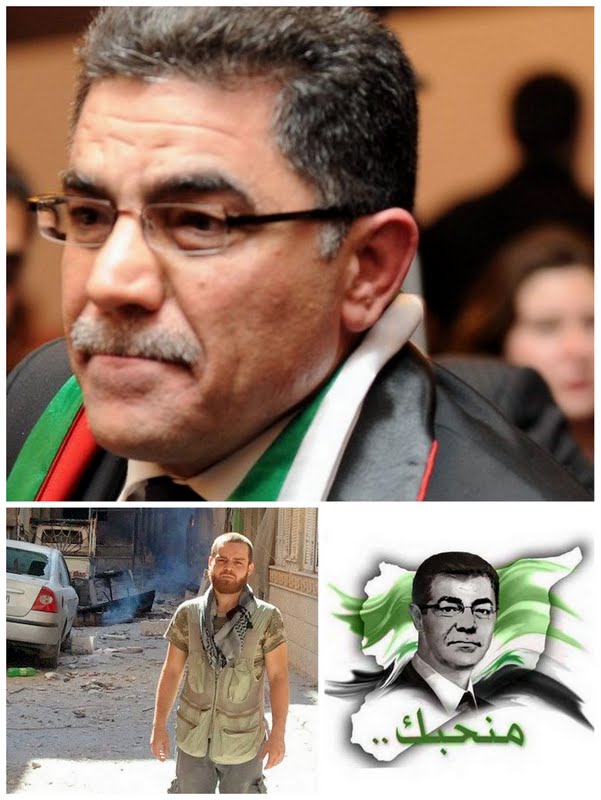
Clockwise from top: Ghassan Hitto, an illustration of kudos, and his son Obaida in Deir Ezzor

Hours after his election as the first prime minister of an interim Syrian government, Ghassan Hitto went on air to address the beleaguered Syria people, saying his administration:
  • Firmly and unequivocally rules out dialogue with the Assad regime.
  • Has “one principal target, which is to bring down the regime by all means and build the New Syria.”
  • Shall kick-start its work from “inside the liberated areas’
  • Shall cooperate closely with the Free Syrian Army (FSA), Higher Military Council and revolutionary forces and endeavor to secure them the military support they need. Together they shall strive to safeguard strategic sites and assets, protect state institutions and take full control of border crossings
  • Shall demand that all humanitarian aid for Syria be channeled through border crossings it controls
  • Shall urge the internally displaced persons (IDPs) to return to their homes in the areas under its jurisdiction
  • Shall uphold all human rights, freedoms and civil liberties and formally foreswear racial, religious, sectarian, gender and ethnic discrimination…
  • Shall invite the international community to extend all assistance possible to the Syrian people
  • Shall request the 130-odd countries that recognized the Syrian National Coalition of Revolutionary and Opposition Forces as the sole legitimate representative of the Syrian people to formally recognize the Interim Government as the legitimate representative of revolutionary Syria
  • Shall demand that all Syrian regime assets frozen or seized by the international community be remitted to the Syrian people through their legitimate representatives
  • Appreciates the political, material and moral aid already extended to the Syrian revolution by such countries as Saudi Arabia, Qatar, the United Arab Emirates, Turkey, France, the United Kingdom, Italy and the United States.

Information technology executive Ghassan Hitto is a naturalized Syrian-born American citizen of Kurdish origin.
He is a 1963 native of Damascus who moved to the United States in 1983.
Last November, the 50-year-old relocated from Wayne in northeast Texas to Turkey to help co-ordinate aid to rebel-held areas.
Hitto, a board member of the Syrian American Council, was already involved in humanitarian aid work stateside, establishing the Shaam Relief Foundation in 2011, and helping organize fundraisers, including a "Walk for Children of Syria Day."
Hitto received 35 votes of 48 ballots cast overnight by members of the opposition Syrian National Coalition, eclipsing other nominees, including Osama Kadi, who I wrongly thought (in an earlier post) would be the man to beat at the meeting in Istanbul.
“A near consensus emerged on Hitto. He is a practical man with management experience and is open to debate. He promised to consult widely before naming ministers and only appoint those with a long experience,” Mohammad Qaddah, the coalition’s representative from Deraa, told Reuters.
Hitto’s first task will be to form his interim government, which will oversee the areas captured from government forces loyal to President Bashar al-Assad.
He earned a bachelor’s degree in mathematics and computer sciences from Indiana's Purdue University in 1989, and a master’s in business administration from Indiana Wesleyan University in 1994.
He is a founding member of the Muslim Legal Fund of America, a U.S. public cause charity established in 2001 to support legal cases impacting civil rights and liberties in America.
Hitto and his wife, Suzanne, an American schoolteacher, have four children, including Obaida, 25, all born in the United States.
Obaida a former high school football player, deferred his plans for law school and sneaked into Syria last year to assist the rebels by making videos and spreading information on the Internet to help their cause.
“Eighty-five percent of the civilian population has left the city,” Obaida said in a Skype interview with The New York Times last September from Deir Ezzor, where he was later injured by mortar shrapnel. “If people only saw what was really happening to the people here they might do the same thing I did.”

Monday, 18 March 2013

Champ Rania, nurse Asma and sniper Umm Jaafar


Chess champion and dentist Rania Abassi

The fate and whereabouts of Syrian dentist and women’s chess champion for many years, Dr. Rania Abassi, her husband and their six children remains unknown after security services took them from their Damascus home last week.
Men believed to belong to the military security branch took Rania’s husband, Aburrahman el-Yassin (Abu Ahmad), from home after ransacking it on March 9.
They returned two days later, March 11, and picked up Rania and the couple’s six children: Dima (14), Intissar (11), Najah (9), Wala’ (8), Ahmad (4) and baby daughter Layan (12 months).
Nothing has been heard of the family since.
Dr. Rania, who won national, Arab and Mediterranean chess championships over the years, is still ranked Syria’s number one woman chess player by the World Chess Federation.
Ghada Ouwais interviewing Asma in Aleppo
Aljazeera TV anchorwoman Ghada Owais is currently in Aleppo doing a series of video features on Syria’s two years of revolt. Last night’s focused on what two young women are doing to help the rebels.
One -- speaking as “Asma”  -- is a volunteer nurse in a makeshift field hospital in a rebel held area of Aleppo.
Owais: Having read Arts at university, why choose nursing?
Asma: We were ready to give our lives for the revolution from day one. When the Free Syrian Army entered Aleppo, most doctors fled. The medical cadres also left. We had to fill in for them, and we did.
Owais: Do you have what you need here to treat patients and the wounded?
Asma: No.
Owais: You’re short of what?
Asma: Everything – equipment, medicines, even bandages. Everything.
Owais: Are you scared?
Asma: No. I am not scared. We fear for the country only…

Sniper Umm Jaafar and husband Mahmoud
After taking leave from the field hospital, Owais says Aljazeera reporter Tamer al-Miss’hal, who is helping her on the Aleppo mission, will take over to introduce “Umm Jaafar.”
Walking viewers through narrow Aleppo alleyways, Tamer says, “The last word on this battlefront is for snipers. Each side tries to prevent the other side’s advance by positioning snipers on rooftops. Here is one of them – a special one. Her name is Noor, but she prefers to be called Umm Jaafar. She has changed.  After owning and running a beauty salon in Aleppo, she is now a seasoned sniper.”
Umm Jaafar: Bashar forced this on us. I was among his supporters until he started the massacres and set about killing children and dumping bodies in the river.”
An incident on an Aleppo street led to her wedding to Mahmoud seven months ago.
Shrapnel from a tank shell outside her home hit Mahmoud. She helped him. They fell in love. They’ve been husband and wife and fighting side by side for seven months.
Tamer: But who’s the boss?
Mahmoud: In the battalion, she is one of the fighters.
Umm Jaafar: You can say that at home I command a brigade while he commands a battalion! 

Sunday, 17 March 2013

Osama Kadi, Syria’s likely interim premier

Osama Kadi (top). Right, with UAE Foreign Minister Sheikh Abdullah bin Zayed al-Nahyan and Farah Atassi

A man for all seasons seems the one to beat in the election of Syria’s provisional prime minister at the two-day meeting of the main Syrian opposition coalition starting tomorrow in Istanbul.
His name is Osama Kadi.
An Aleppo native, he has lived, studied and worked, as an economics consultant, in Syria, Canada and the United States.
He now leads the Syrian opposition taskforce drawing up plans for post-war economic recovery
To boot, he is a theater director.
Kadi is a member of the Syrian National Council (SNC), the largest component of the Syrian National Coalition of Revolutionary and Opposition Forces (SNA) headed by Moaz al-Khatib.
Two previous SNA attempts to name an interim prime minister were postponed over seemingly intractable differences. Consensus has been building as the Syria war enters its third year.
French President François Hollande first floated the idea of an interim government, which would help administer the large swaths of land in the north and northeast the rebels have seized, in August 2012.
Hollande at that time told French ambassadors in an annual foreign policy speech, “France asks the Syrian opposition to form a provisional government — inclusive and representative — that can become the legitimate representative of the new Syria.”
The Council of Arab Foreign Ministers picked up the baton earlier this month with a resolution urging the SNA to form an “executive body” to take up Syria's vacant seat at the Arab League and represent Syria at the upcoming Arab summit in Doha.
The SNA announced overnight on its Internet page the names of nine nominees for prime minister. It separately said on its Facebook page it was keeping secret the names of two other nominees for their own safety since they still live in Syria.
Frontrunner Kadi is:

Kadi did economics consultancy work for the Syrian Agency for Combating Unemployment and the United Nations Development Program (UNDP) in Syria.
Stateside, he taught macro- and microeconomics at the Dearborn campus of the University of Michigan and business management at Baker College of Allen Park. His paper “Who Reaps the Benefits of peace in the Middle East” was presented at the 1994 MESA (Middle East Studies Association) conference in Washington.
He has also written innumerable articles and papers on economics and politics for Syrian, Arab and international journals.
The London-based Strategic Research & Communication Centre published his 2011 study titled “Syrian Industry and the Problem of the Executive” on the eve of the Syrian revolt.
Kadi is on the active membership rolls of the:
  • American Economic Association (AEA)
  • Syrian Economic Science Association (SESA)
  • Middle East Studies Association (MESA)
  • Middle East Economic Association (MEEA)
  • Middle East Institute (MEI)
  • Academy of Political Science (APS)
  • Western Economic Association
  • American Sociological Association
  • American Association of University Professors (AAUP)
  • United Nations Association in Washington DC
  • Canadian Association of Journalists

Stage director Kadi in action
Going back to “a man for all seasons,” Kadi is a theater actor and director in his spare time.
He co-founded the Risala Theatrical Group RTG in Canada, performed on stage there and in the United States.
The last theater production he directed in September 2011 – “Abu Sultan’s Family” – showcases the life of a Middle East family that immigrates to Canada in pursuit of a better life.

Saturday, 16 March 2013

Regional turbulence ahead, fasten your seatbelts


Waddah Khanfar
Waddah Khanfar, 45, is the president of Al Sharq Forum, an independent network dedicated to developing long-term strategies for political development, social justice and economic prosperity of the people of the Middle East. He previously served as the Director General of the Aljazeera Network. In 2011, Foreign Policy Magazine ranked Khanfar first in “The FP Top 100 Global Thinkers.” In 2009, Forbes Magazine named him one of the most “Powerful People in the World.” He penned this think piece in Arabic for aljazeera.net:

The Syrian regime having turned to Scud missiles, and with Russia and Iran keeping up their arms supplies to the Damascus government, the British and French assume that providing some weapons to the rebels would somewhat level the sides’ firepower and prod the regime to negotiate with the opposition.
The idea by some in the West of working for a peace settlement by redressing the military balance won’t work. It won’t help stop the violence.
It would simply gain the regime more time and lay the first stone for greater and more vengeful violence. The move would inflame the situation and broaden the field of conflict to engulf the whole region.
Many reasons are at work to expand the Syria crisis and give it a regional dimension.
The Arab Mashreq is one of the world’s most diverse regions in terms of sects, ethnicities and religions.
The Syria crisis is getting deeper and thornier because of gory terrorism by Syria’s sectarian regime, Russia’s accolades and Iran’s giveaways to Assad, America and Europe’s hesitation and the Arab states’ muddled disposition towards the multiple Syrian revolution sides.
Regional amplification of the crisis has thus become a matter of time. This is to say the Syria crisis will become, in the course of its third year, an open-ended trans-boundary conflict posing the biggest challenge yet to the stability of the region since its current borders were mapped out a century ago in the aftermath of the First World War.
Mushrooming of the Syria crisis will first envelop Lebanon, which is closest to Syria.
The strategic axis extending from Tehran to Baghdad, to Damascus, and on to Hezbollah in Lebanon believes the Assad regime’s fall will reconfigure the region’s strategic balances.
That’s what drove Hezbollah to be the first Lebanese side to stick its nose in Syria and give political and logistical support to Assad’s regime. That’s what prompted other Lebanese sides to back the Syrian revolution.
Tension and polarization peaked in Lebanon after its internal two-year rope war. The country is now exposed to the fire and brimstone of the Syria crisis with all its bloody violence and sectarian overtones.
Despite the seriousness of an eruption of violence in Lebanon, a spread of hostilities in the direction of Iraq is the more ominous development in the making.
The preliminary signs are evident in the mounting political strains between the Maliki government, which is prone to sectarianism and backs Bashar al-Assad, and all the predominantly Sunni provinces on the one hand, and between Maliki and Iraq’s Kurdistan Region on the other.
It seems the three months of ceaseless protests in the Sunni areas have reached a dead-end.
The Maliki government did not meet the demonstrators’ demands for greater sectarian evenhandedness in Baghdad. Instead, the government escalated its repression of protesters and embraced violence.
This risks opening the Iraqi arena to a new cycle of grisly violence that will find its natural extension in the inflamed Syrian mainland.
Iraq, which is yet to recover from a civil war that tore to pieces its national unity between 2007 and 2009, is expected to take sectarian strife in the region to unparalleled levels.
Iraq’s neighbors – Iran, Turkey and the Arab Gulf countries – will find themselves drawn into the inferno.
The struggle over Iraq will not only be over its huge oil resources, but also over the heart and soul of the upcoming Middle East. The latter will determine the weights of the regional powers and chart the region’s new political map.
Is such a bleak scenario preventable?
The answer lies in what regional and international players do in the few months ahead, starting with the United States precluding its past mistakes and making removal of the Syrian regime its top priority.
Although direct military intervention is not welcome, the prerequisite is to provide the Syrian revolution with the necessary qualitative weapons without engaging prematurely in side issues over the local balance of power post-Assad Syria.
The U.S. administration was nonplussed and undecided on Syria in the past two years. It blocked the flow of qualitative weapons to the rebels in Syria under different pretexts. These included Washington’s apprehension of post-Assad scenarios and of Islamists ruling in Damascus at Israel’s doorstep.
America also did not want to see such weapons “fall into the wrong hands,” meaning Jihadists and groups close to al-Qaeda.
Such American hesitance proved disastrous. It failed to prioritize the removal of a terrorist regime bent on killing, destroying and raping for fear of a potential terrorism threat.
The U.S. made the mistake when the Syrian revolution was miles away from the influence of al-Qaeda and its offshoots.
This emboldened the regime, allowing it to raise the level of its violence against civilians to unprecedented heights.
Likewise, the international community’s dawdling and indecision on supporting the Free Syrian Army and the moderate rebel brigades allowed Jihadist groups to join the fray.
It is atypical not to see oppression victims turn to whoever can defend them. It took Jihadist groups, including Jabhat al-Nusra, which the U.S. designated as terrorist, more than a year to make their entry into the Syria scene.
The U.S. decision was also misguided in that it shifted the international community and regional forces’ priority from bringing down the regime to fighting Jihadists.
Moreover, U.S. blacklisting of al-Nusra empowered the group further after it proved to be more disciplined than the other armed groups and refrained from antagonizing Christian, Druze and Alawite minorities.
The lack of a clear strategy vis-à-vis the Syrian revolution sent conflicting signals to regional countries. Those fearful of the “Islamist threat” chose to arm groups of no consequence in Syria, which served the regime well and embittered the revolution’s mainstream.
The most important thing the countries of the region need to do is formulate a common position on the Syria priorities.
Downing the regime posthaste is the imperative step liable to stop the slide towards unbridled violence.
Focusing on the attendant post-Assad fears and trying to meddle in the rebel groups’ political and military balance of power will work for the regime and for the scenario of full-blown chaos and sectarian strife. 

Friday, 15 March 2013

Pointers of Washington going soft on Assad


Haytam Manna' (right) who met Lavrov in Moscow March 11 is now in the U.S.
The oscillating compass needle of Washington’s Syria policy stabilized this week on seven signals.
I singled out one.
Raghida Dergham today lists the other six in her weekly think piece for pan-Arab al-Hayat.
So let me start with hers.
Filing for al-Hayat from New York, the American-Lebanese seasoned political analyst high spots her six:
1. A reversal of Obama One’s interpretation of the June 2012 Geneva framework concerning Syrian President Bashar al-Assad’s role in a political transition. Obama Two’s new Secretary of State John Kerry is now saying, “We want to see Assad and the Syrian opposition come to the table for the creation of a transitional government according to the framework that was created in Geneva.”
2. A preemptive blow to the GCC partners in the countdown to the March 26-27 Arab summit in Doha after the Saudi-Qatari push to describe Assad as having lost his legitimacy and chosen to destroy the country in order to hang on to power.
3.  A submission to the Russian position that Assad is a “red line.” The hope is that Kerry’s concession to the Russians will be counterbalanced by concessions they can win from the Syrian regime.
4. A dawn of contradictions, rashness or a distribution of roles involving the United States, the United Kingdom and France. Kerry designating Assad by name as kosher interlocutor is irreconcilable with the positions of his British and French counterparts and allies in the UN Security Council. Kerry’s position is equally at odds with Hillary Clinton’s.
5. A shot in the arm to the mission of Syria troubleshooter Lakhdar Brahimi, who wants to dissociate the Assad Gordian knot from the commencement of dialogue and negotiation.
6. A pull of the rug from under the Syrian National Coalition’s feet in that Kerry’s bolt out of the blue risks splintering SNC ranks and forcing the resignation or dismissal of its leader Moaz al-Khatib.
My seventh signal of the U.S. policy shift:
Within 72 hours of his talks with Russian Foreign Minister Sergei Lavrov in Moscow, Syrian dissident Haytham Manna’ – who is outwith the SNC and is a strong critic of the Free Syrian Army -- landed in the United States for presumed talks with its National Security Council and State Department officials.
Here’s how State Department spokesperson Victoria Nuland handled questions about Manna’s visit in her press briefing yesterday:
Q.: There’s a Syrian opposition delegation --
MS. NULAND: (Sneezes.) Excuse me.
Q.: Bless you.
Q.: Bless you.
Q.: -- that will be in town later this week, or maybe next week, with – headed by Mr. Manna’. Any meetings they are holding here at this building?
MS. NULAND: This is a different Syrian opposition group, or this is some – or representatives from the SOC [Syrian Opposition Coalition]? I’m not sure I know which meeting we’re talking about.
Q: He – no, no. Mr. Manna’ is not with the SOC.
MS. NULAND: I will have to check on that one. I don’t know about that meeting.
Q.: Is there a delegation of the SOC?
MS. NULAND: No. We haven’t yet, as we said yesterday, set dates with them for their visit to Washington.
Q.: I just wanted to follow up. Are you in contact with Mr. Haytham Manna’? He’s a quite a national figure in Syria – resides in France, I think.
MS. NULAND: I would guess that Ambassador Ford and his team do have contact with him. If that is not the case, we’ll let you know.
But overnight Manna’ himself posted the following on his Facebook page:
A delegation of Syrians will be visiting New York on March 13-15 and Washington on March 17-20 in pursuit of peace. The delegation, associated with The Democratic Civil Alliance (DCA) that emerged as a follow up to the “Geneva Declaration” of January 29. It represents a broad coalition committed to non-violence, democracy, pluralism and non-sectarianism and unites around a clear political plan for a negotiated solution in Syria based on the Geneva Communiqué of June 2012. Delegation members are seeking meetings with policymakers, experts, diplomats, UN staff, media and NGOs.
The DCA, considered to be one of the largest and most influential within Syria, brings together well-known Syrian human rights activists, professionals, political parties, and civil society groups, many of who have worked within the National Coordination Body for Democratic Change and Building The Syrian State current. Sharply critical of the dictatorship of Bashar al-Assad and his violent repression, these Syrians are also critical of the increasingly militarized rebellion, the foreign arms flowing to both sides of the military conflict, and the Islamic fundamentalist influence within the rebel military forces. The Democratic Civil Alliance brought together all these forces around very solid and clear plan for negotiated political solution. They are reaching out to all Syrian players, political, civil society or even military players to join this alliance to find a safe solution for the country that puts an end to the violence that started spilling over the borders and is forming the perfect nurturing environment for extremism.
The mainstream international media tend to ignore the large secular and democratic movement within Syrian society and the complex multi-religious and multi-cultural nature of Syria, where there is broad opposition to a post-conflict Islamic government and fear of reprisals and of ongoing conflict after the fall of the dictatorship. The delegation reflects this perspective and aspires to find the broadest international support for its political plans. The three-member team has important political roles in the Syrian internal political scene.
Delegation members:
Dr. Haytham Manna’ has been a Syrian human rights advocate for over three decades. Manna was born in Syria and studied medicine at the University of Damascus. He now lives in Paris where he practices medicine and is the lead external spokesperson for The Democratic Civil Alliance. He has won awards for his human rights work from, among others, Human Rights Watch and the U.S. National Academy of Sciences. He is co-founder of the Arab Commission for Human Rights and has served in leading roles in several other human rights organizations. He is the president of the National Coordination Body for Democratic Change in exile and the vice-president of the Syrian-based branch of the organization.
Dr Rim Turkmani is a founding member of the Building The Syrian State current which has made prominent cease-fire plans, worked to organize peacemaking groups at the local level and cooperated with UN Special Representatives Kofi Annan and Lakhdar Brahimi to promote a negotiated political solution. She is also a member of the executive committee of The Democratic Civil Alliance
She is an Astrophysicist at the Imperial College in London and is a specialist in the history of Arabic/Islamic science and its influence on the West. She has published many papers and books both on scientific and historical topics. She is the founder and co-chair of The Damask Rose Trust, a UK-based charity that supports development and education in Syria.
James Paul, senior advisor at Global Policy Forum and author of Syria Unmasked (Yale Press), and Mel Duncan, advocacy director of Nonviolent Peace Force, will host the visit. Both attended the Geneva Conference on Syria in January.