Pages

Tuesday, 15 May 2012

“U.S. spooks and Lebanon’s Tripoli clashes”


Tripoli gunmen in action (Photo from Lebanon's daily an-Nahar) 

The Beirut daily al-Akhbar, which is a leading mouthpiece for Syria in Lebanon, claims a tipoff from U.S. intelligence is what brought about the arrest by Lebanon’s General Security Department of Syrian opposition supporter Shadi al-Mawlawi in Tripoli.
The arrest -- linked to unrest in neighboring Syria -- sparked off three days of clashes between Lebanese Alawites and Sunnites in Lebanon’s second largest city that has recently become home to thousands of Syrian refugees fleeing the violence in Syria.
The faceoff since Saturday between Tripoli's two adjacent districts -- the predominantly Sunnite ‘Bab al-Tebbaneh’ and the overwhelmingly Alawite ‘Jabal Mohsen’ -- has left eight people dead and about 80 injured.
The General Security Department arrested Mawlawi, a Lebanese Sunnite Islamist opposed to the regime of Syrian President Bashar al-Assad, after luring him to a government minister’s welfare association office to supposedly receive healthcare assistance.
Lebanese security separately arrested other men, including one Jordanian and one Qatari.
A military prosecutor has now charged Mawlawi “of belonging to an armed terrorist organization.”
According to al-Akhbar, “several (Lebanese) security officials say U.S. security agencies informed the General Security Department that a Jordanian by the name of Abdelmalek Abdessalam had crossed into Lebanon from Syria and is about to leave the country.
“The Americans said Abdessalam coordinates al-Qaeda activities in several countries, among them Afghanistan, Iran, Pakistan, Syria, Lebanon and Jordan. The General Security Department having alerted the border crossings, Abdessalam was held at Beirut International Airport when trying to board a flight to Amman.
“Abdessalam confirmed the suspicions against him during interrogation… He admitted receiving funds from a Qatari citizen, Abdelaziz al-Atiyah, who was also seized at his hotel (in a Beirut suburb), where he was recovering from surgery. He has now been moved to a hospital in Mount Lebanon.
“Abdessalam gave interrogators the nom de guerre of his Lebanese contact as ‘Adam’… A phone number tracked down ‘Adam,’ who turned out to be Mawlawi.”
Lebanese army regulars and police forces are today patrolling Tripoli and seem to have restored calm.
The army said in a statement its units finished deploying in the violence-stricken areas of the city, including Bab al-Tebbaneh, Jabal Mohsen and the Syria Street separating the two neighborhoods bitterly split over loyalties linked to the Syrian uprising.
The number of Lebanon’s Alawites is undetermined, varying between a high of 120,000 and a low of 70,000. About 60 percent of them reside in Jabal Mohsen. Most of the rest live in the north Lebanese governorate of Akkar.
No Alawite has ever been named government minister in the Republic of Lebanon’s history. And it was only three years after the 1989 Taef Agreement that Alawites were able to fill their two allocated seats in the 128-member Lebanese parliament.
Both Alawite legislators in the current parliament – Khodr Habib and Badr Wannous – were elected on a (anti-Assad) Future Movement ticket.
But the uncontested overlords of Lebanon’s Alawites are Ali Eid and his son Rifaat, both diehard supporters of Syria’s Assad dynasty. Rifaat was once quoted saying, “Our special links to Syria, of which we are proud, are no different than the Shiites’ to Iran, the Sunnites to Saudi Arabia, or the Maronites’ to France.”
Lebanese political analyst Rosanna Boumounsef today notes in her daily column for Beirut’s independent daily an-Nahar the Syria crisis has left the government of Prime Minister Najib Mikati in a quandary.
“Whereas the stands of the premier, his ministers of interior and of finance and parliamentarian Walid Jumblatt were critical of the security agency’s malapropos arrest that caused the turmoil in Tripoli, government ministers and legislators belonging to the (pro-Assad) ‘March 8’ coalition defended it… The split can only add fuel to the fire.”
Progressive Socialist Party leader Jumblatt says in remarks for his PSP weekly al-Anbaa published today:
“It is not the first time tension and acts of violence grip Tripoli…
“You cannot dissociate events there from the diligence of some security agencies – apparently motivated by Syria – in deeming Salafism an absolute evil. I wish one of these agencies’ bigwigs would come forward to define to us Salafism.
“Why this dogged insistence on magnifying the Salafist threat? How pervasive is it in Lebanon? Is it restricted to Sunni Muslims? Why is it constantly linked to terrorism…?
“Aren’t we being led to believe Lebanon has become a Salafist hub so we cutoff help and humanitarian assistance to Syrian refugees in Lebanon and (acquiesce) to the arrest of activists among them who would then be handed over to the authorities in Syria to face execution?
“And why this determination to ‘import’ al-Qaeda to Lebanon at all costs? Will al-Qaeda also be used as a scarecrow to gag Lebanese support for the Syrian revolution and the Syrian people who are facing the systematic and daily crimes being committed by the regime in Syria?
“…Why the lack of full coordination among all Lebanese security agencies? Is it because each has it own political patron?
“…Does this explain why telecom date was not released to a security branch trying to uncover the persons behind the attempt on the life of Lebanese Forces chief Samir Geagea?
“…Better we calmed things down and opted for reconciliation to clear the atmosphere in Tripoli… Better we devised a wide-ranging economic development plan to tackle Tripoli’s misery and resumed the national dialogue on a comprehensive national defense strategy under state authority…”

Monday, 14 May 2012

نقل فؤادك حيث شئت من الهوى .... ما الحب إلا للحبيب الأول

My first love at first sight

My bullet-riddled Alfa Montreal
Let your heart meander along the passion path,
But love forever belongs to your first-love.
No matter how many homes a lad fancies,
He’ll everlastingly yearn for his first.
It’s the closest I could get in translating the following Arabic verses dating back to the ninth century:
نقل فؤادك حيث شئت من الهوى
ما الحب إلا للحبيب الأول 
كم منزل في الأرض يعشقه الفتى
و حنينه أبدا لأول منزل

They belong to Syrian-born poet Abu Tammam who spent his youth in Homs, of all places.
According to contemporary Syrian poet Adonis, Abu Tammam "started out from a vision of poetry as a sort of creation of the world through language, comparing the relationship between the poet and the word to the relationship between two lovers…”
All this is to recount my first love at first sight – not of a woman but of a supercar.
Of all the Volkswagen Beetles, Chevrolet Camaros,  Nissan Patrols, Mercedes and BMW 4x4s I owned and drove over the years, my heart belongs to that supercar.
It was a hot summer night in 1973 and I was walking towards the Palm Beach hotel on Beirut’s seafront when I passed by the Ain el-Mreisseh showroom of “Bassoul-Hneine” car dealership. “Bassoul-Hneine” were and still are the agents for several car makes, chiefly Renault and Alfa Romeo.
The showroom was well lit. The sight of a supercar in metallic gold, sitting majestically at one end of the showroom, hit me like lightening. It was indeed love at first sight.
After spending some 10 minutes admiring it from the front and the driver’s side only, because of the way it was parked, I spent a good part of my shuteye time wondering about its interior, its specifications, and above all its price.
Bassoul-Hneine were regular advertisers in my weekly magazine. So first thing in the morning I called in my advertising manager Adel Merhi and described what I saw.
File photo of a Montreal in mint condition 
I said, “Adel, in two words: Go buy me that car from our client Bassoul-Hneine. I presume the price is prohibitive, so try for a cash-and-barter deal.”
Within maybe two hours, Adel rang me from Bassoul-Hneine to say, “The car is mindboggling. It’s their one and only ‘Alfa Romeo Montreal’. But the dealership wouldn’t budge on the price (the equivalent in Lebanese liras of $14,000, if I remember correctly) – 90 percent in cash upfront and 10 percent in advertising space.”
I answered Adel, “Do the deal, but don’t leave the showroom before they put a ‘Sold’ tag on the car. We will finalize and pick up the car tomorrow.”
That’s what we did.
On starting the engine, I was thrilled to hear a vigorous V-8 roar. And the five-minute drive home felt like sitting in a fighter jet ready to launch.
On arriving home to take my three excited little boys’ for a spin, I could see their popcorn leaping out of its box.
The Alfa Montreal was a technological flagship. It was innovative, impressive and expensive. It was more expensive to buy than the E-type Jaguar or the Porsche 911.
The Montreal's design by Giuseppe Bertone was anything but conservative. Among its innovative features were headlight eyebrows that pivoted down only when needed to give the car a clean, menacing look with its headlights off.
The Montreal's dashboard and five-speed manual gearbox
One of its key features was an easy-revving, small displacement gem of a V8. A detuned version of the 33/2's brilliant engine was dropped into the front of Alfa's Montreal. This motor, with its tidy alloy construction and SPICA mechanical fuel injection, was far ahead of its time. It made 200hp out of just 2.6 liters, a very respectable specific output for a naturally aspirated car. A five-speed manual gearbox and ventilated disc brakes were also used. In short, it was one of the liveliest powerhouses of its day.
There were 3,917 Montreal's produced between 1971 and 1975 and they were never exported to the United States.
Enjoyment of my Montreal lasted just over a year. By late 1974, the steady rumble of an approaching civil war had me send the family to England.
By early 1975, the internecine strife in the country saw me hide my “first love at first sight” in the basement garage of the Sabbagh Center on Hamra Street, where I had a PR boutique.
A stray shell hit the office within months, but the Montreal remained safely “mothballed” in the third level basement for a year-and-a-half.
A lull in the civil war in 1977 encouraged me to get the car out with the help of car electricians and tyre mechanics. But most if not all highways and inner city roads were inaccessible, roadblocks were everywhere, the gas pumps were invariably dry and carjackers were a good many.
Within weeks of its recovery from “internment” in the Sabbagh Center, the Montreal was riddled with bullets while parked in front of my building during a firefight involving al-Mourabitoun and a rival militia.
It was time I thought to part ways.
I agreed to sell the Alfa superstar to a dear friend who wanted it for his younger brother. The brother escaped unhurt when he crashed it beyond repair within months.
That first love at first sight was also my last.

Saturday, 12 May 2012

Syria and al-Qaeda: A love-hate relationship


Syria's Bashar al-Assad and al-Qaeda's Ayman al-Zawahiri
The love-hate relationship between Syria and al-Qaeda enthralls Arab political analysts.
Three of them specifically delve into the liaison today as:
  • the state-run Syrian news network Champress releases the names and nationalities of what it claims to be 26 “terrorists” – 20 of them al-Qaeda operatives -- captured by government authorities, and
  • a statement by the opposition Free Syrian Army (FSA) requested a UN-mandated commission of inquiry to determine who stands behind Thursday’s twin bombings in Damascus and why. The statement denied the FSA was behind the blasts, accusing the regime instead of carrying them out to discredit the opposition.
Of the 26 “terrorists” named in the Champress document, 20 are Tunisian, two are Lebanese, one is Lebanese-Palestinian, and the remaining three are one each from Libya, Egypt and Jordan.
Champress says the official document with the full names, personal details, particulars and date of arrest of each of the 20 al-Qaeda and six other “terrorists” was submitted by Syria’s permanent UN representative Bashar at-Jaafari to the UN Security Council.
The document shows most of the “terrorists” had infiltrated into Syria through Turkey and were captured in March.
The FSA statement, for its part, said, “The illegitimate Syrian regime continues to kill and target unarmed civilians through bombings in Damascus and other cities. (Thursday’s twin) bombings in Qazaz are another desperate attempt by the regime to support its claims regarding the existence of ‘terrorists’ and ‘armed gangs’.
“It has been conclusively proven these bombings are perpetrated by the illegitimate regime, and we request the following to be taken into consideration:
  • “The bombings followed Kofi Annan’s recent statements, which suggested the Syrian regime may not be adhering to the six-point peace plan...
  • “The FSA does not possess the necessary capability to conduct such bombings
  • “A car containing bodies of detainees was found on the site… and it was later discovered it was brought to the affected area
  • “The speed with which state-run news agencies showed up at the scene to provide live coverage
  • "The FSA is incapable of reaching the site of the explosions, as it is a heavily guarded security complex
  • “The summoning of UNSMIS mission chief, Gen. Robert Mood, to the site of the explosions for him to give statements that may serve the Syrian regime’s claims
  • “FSA members defected from regime forces to protect civilians, not to harm them.
“Therefore, we condemn this cowardly terrorist act and hold the regime fully responsible for it. We ask the UN to set up a team of international experts to investigate these bombings, and urge Mr. Annan to declare the failure of his peace plan, and to hold the regime accountable for the failure. We also call for the arming of the Free Syrian Army and request an emergency UN Security Council meeting, so it can pass a resolution under Chapter 7 facilitating the protection of Syrian civilians.”
Ali Hamade, political analyst for the independent Beirut daily an-Nahar, focuses today on what he calls Syrian President Bashar al-Assad’s “love story” with al-Qaeda.
Few people, he writes believed the Syrian regime’s narrative about the twin-bombings in Damascus, opposite the infamous “Palestine Military Branch” where regime opponents are interrogated and tortured.
“Few expressed their condolences to Assad. Few believed the regime’s innocence of a crime that harmed ordinary civilians more than it hurt the regime’s shabiha militia or its Palestine Military Branch criminals.
“Few believe the regime was not al-Qaeda’s partner for several years in Iraq’s dance of death as well as al-Qaeda’s death dancing partner for four decades in Lebanon.”
More recently, Hamade notes, didn’t Syria also manufacture “Fatah al-Islam” in Lebanon? It is an open secret, he says, that today’s al-Qaeda is “a gun for hire” – much as the Carlos terrorist group of the Seventies.
Hamade says the February 2005 assassination of Lebanon’s Rafik Hariri marked the pinnacle of four-way cooperation linking Syria, Iran, Hezbollah and al-Qaeda.
According to Tariq Alhomayed, editor-in-chief of Saudi Arabia’s leading daily Asharq Alawsat, “Thursday’s Damascus bombings show the Assad regime’s ruse paying off this time… The regime succeeded in hard-pressing all sides – the Syrian opposition as well the international community… When the Assad regime decries the death of 55 Syrians in the Damascus bombings, why does no one ask him about the 12,000 Syrians his regime killed over the past year?”
The head of Saudi-owned Alarabiya television news channel Abdul Rahman al-Rashed, also writing of Asharq Alawsat, says Damascus was heartened and couldn’t believe its ears on hearing US Secretary of Defense Leon Panetta tell reporters late on Thursday that intelligence indicates there is an "al-Qaeda presence in Syria… Frankly we need to continue to do everything we can to determine what kind of influence they're trying to exert there."
Rashed says, “The Syrian government wants to convince the world that it is fighting terrorists, al-Qaeda and the forces of darkness, not a popular uprising standing up to a brutal regime. That’s what Damascus is desperate to make Western public opinion believe.”
The regime is a maestro at concocting terror scenarios to serve its own ends. It proved it in Lebanon by simultaneously assassinating Rafik Hariri and concocting the storyline of “Abu-Adass.” It confirmed in Lebanon again in 2007, when it planted Fatah al-Islam in Nahr al-Bared. It also proved it by gathering al-Qaeda volunteers from across the region before ensuring their safe passage to Iraq. It is now frantically trying to persuade the world to choose between Bashar al-Assad and Ayman al-Zawahiri.

Friday, 11 May 2012

Saudi pink Everesters are on course


The garlanded climbers pose for a picture (top right) before taking the long
flight to Kathmandu the night of May 6-7. A small plane (right) took them
the early morning of May 8 to Tenzing-Hillary airport in Lukla. The photo to the
left shows the group relaxing outside an authentic Sherpa home in Lukla

Eleven Saudi women flew out the night of May 6-7 to the Nepalese capital Kathmandu on the first leg of their two-week journey to try and scale Mount Everest.
Their campaign -- dubbed “A Woman’s Journey – Destination Mount Everest” – aims to promote awareness of breast cancer, express moral support for women sufferers and underscore the importance of healthier lifestyles and physical fitness.
All 11 Saudi women taking the breast cancer fight to the earth’s highest mountain – who I introduced in an earlier post -- have relatives or friends who fought or are fighting the ailment.
Led by HRH Princess Reema Bint Bandar Bin Sultan Bin Abdulaziz Al Saud, the driving force behind the May 7-21 campaign, they are: Alya Al-Sa'ad, Hatun Madani, Mona Shahab, Noura Bouzo, Lina Al-Maeena, Samaher Mously, Asma Al-Ghalib, Mashael Al-Hegelan, Hasna’a Mokhtar and Raha Moharrak.
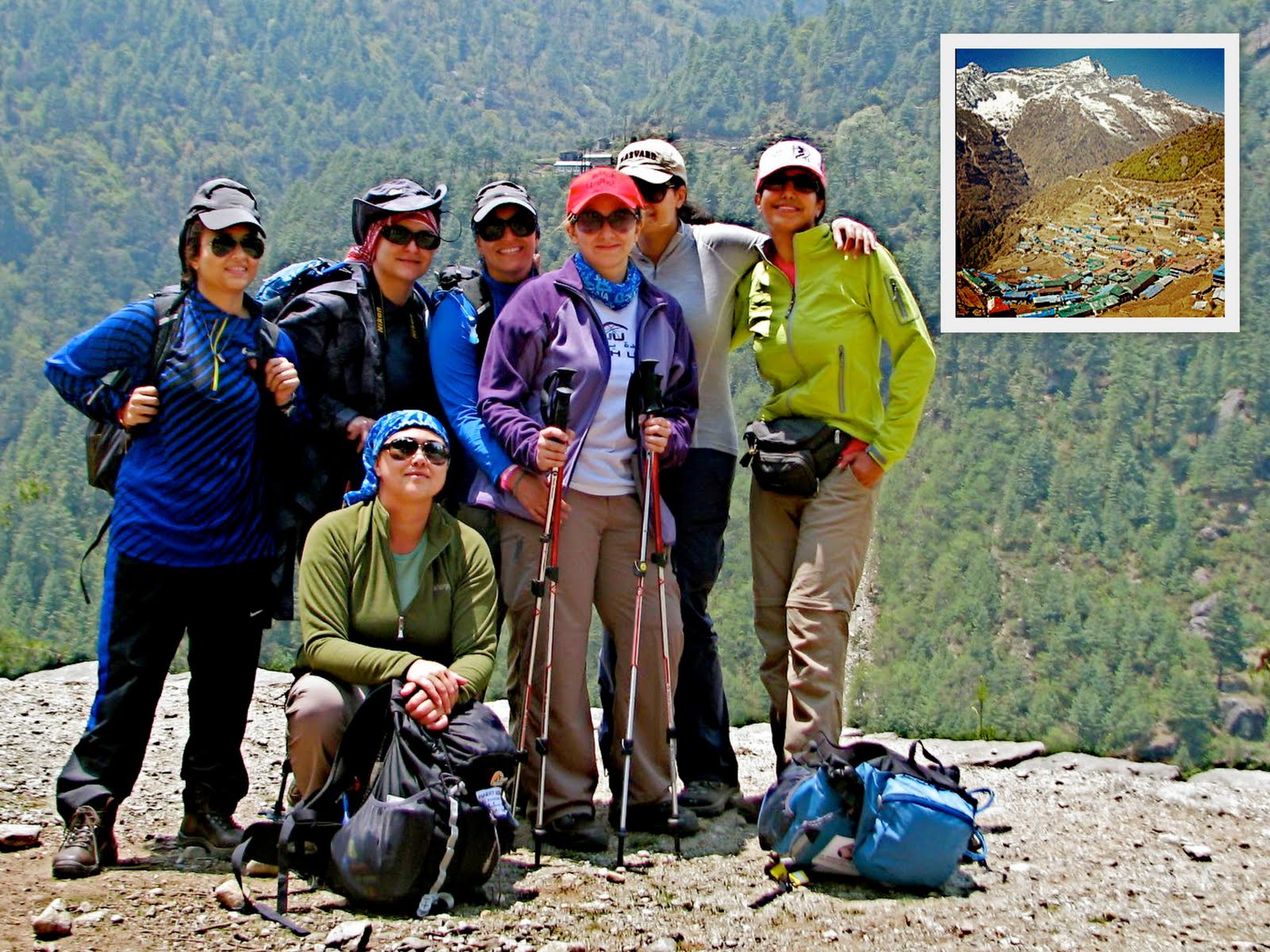
Here is a photo update on their progress so far. The photo originals are from their Facebook page:

From Lukla, the trek led the climbers to the banks of the Dudh Koshi (or milky
river, inset) and on to the town of Phakding, where they are shown resting

May 9: The Saudi pink mountaineers seen crossing the confluence of the Dudh Koshi and
Bothe Koshi on a high-suspension bridge before their steep climb to reach Namche Bazaar


Seven of the climbers pose for the camera on the way to Namche Bazaar (inset)

This May 10 group photo of the 11 girls was taken outside Hotel Camp de Base
in Namche Bazaar. They were to set out this Friday morning on a six-hour
trek to Thyangboche at 3,780 meters. Thyangboche is the spiritual center for the Khumbu,
a training center for new monks. It is also the home of the famous Sherpas

One of the Saudi pink climbers nailing a "Fight Like a Girl" T-shirt
onto the wall of a local cafe in Namche Bazaar. This is a
common tradition for all Mount Everest Base Camp trekkers!


Thursday, 10 May 2012

Syria: The “Assad-or-war” debate rages on


Funeral for civilians killed in Kafar Souseh last week

Abdul Rahman al-Rashed, head of Saudi-owned Alarabiya television news network, today faults a prominent Syrian activist for joining international mediator Kofi Annan in warning that failure of the political process in Syria could lead to a civil war that won’t affect only Syria but the whole region.
Syria’s leading political activist Michel Kilo, writing for Wednesday’s edition of the Saudi daily Asharq Alawsat, suggested the only viable alternative to President Bashar al-Assad’s regime “is either a vicious and protracted internal and regional war or an international confrontation between the Great Powers.”
“That’s what Kilo wrote in his think piece for Alawsat yesterday,” Rashed writes today for the same newspaper. “His (Kilo’s) analysis joins the wrapping up in Kofi Annan’s report (to the UN Security Council). Remember Annan launched his mission last February on the same premise, saying -- even before setting foot in Damascus – that a civil war is looming.”
Rashed opines:
We know Annan was nominated to head the Syria mission by the Syrian regime’s backers – namely, the Russians and the Arab League secretary-general. This explains why his report was conciliatory to the regime and its allies.
The same cannot be said of Kilo, the man of mettle hailing from Latakia who spent years behind bars for opposing the regime and holding to his political convictions. But I certainly dispute his setting a ceiling of two options -- the regime or war.
I think if you asked the Syrians today, the regime’s downfall is their only preference, irrespective of the timeline and suffering involved.
To suggest Syria is suffering the consequences of a struggle between Saudi Arabia, Qatar and Turkey on one hand and Iran and Russia on the other is an affront to the unarmed Syrian civilians who protested for a year without receiving a single bullet, medicine or dollar in aid from anyone.
What is happening in Syria is not the brainchild of either Saudi Arabia or Qatar, but a genuine uprising against a hideous regime. It is an uprising involving the majority of the Syrian people against the Syrian regime and its backers -- an inborn revolt against the world’s most cruel regime, a regime unreceptive to conciliation or reform.
The Syrians are aware all the talk of elections and reforms is a pack of lies. They thus face two stark choices: a confrontation of many years or one of fewer years. But in the end, the regime won’t withstand the people’s hatred and their yearning to bring it down.
If Kilo foresees the revolution evolving into a civil and then regional war leading to Syria’s fragmentation into mini-states, why should that be worse than keeping Assad at the helm in Syria?
What Kilo, Annan, Russia’s Sergei Lavrov and the Arab League’s Nabil Elaraby are saying can be put in one sentence: keep the regime in place…
Thinking out loud, is Assad likely to stand down, allowing a peaceful transfer of power as happened in Yemen?
The answer is: certainly not.
Would the regime dismiss Assad and restructure from within as happened in Tunisia and Egypt?
Again, the answer is: definitely not.
Could Assad’s regime be forcibly brought down internally?
Yes, by way of a mushrooming intifada overpowering the blockade after a year or two.
Is there a chance of Syria splintering, along Alawite or Kurdish lines for example?
Possibly, yes.
Would that trigger a civil war?
Possibly, yes too.
Going over the main points, would the Syrians desist and stay home for fear of the country’s partition or a civil war?
Absolutely not, because remaining under Assad’s regime is worse than risking a state of war.
If Kilo initially assumed uprooting the regime was going to be a walkover, he was wrong. He is equally wrong if he believes today that returning to live under Assad is like returning home after watching a film at the local cinema. So let’s focus on a solution that would evict the regime, not keep it – as peacefully as possible, or differently. 

Wednesday, 9 May 2012

Damascus intensifying mass arrests -- Annan


By renowned Syrian cartoonist Ali Ferzat 

International envoy Kofi Annan says Syrian troops appear to be intensifying mass arrests and torture in rebellious communities.
Diplomats say Annan made the comments on Tuesday in a closed briefing to the UN Security Council via videoconference from Geneva.
One diplomat said Annan did not sound optimistic. 
"I won't call him optimistic," the diplomat said of Annan's briefing behind closed-doors. 
 He quoted Annan as saying his six-point peace plan is not an "open-ended" commitment and it is "possibly the last chance" to avoid a civil war. 

He also quoted Annan as saying violence must stop and a credible political process must start, "not like yesterday's elections."
According to other diplomats, Annan said the onus remains on the Damascus government to create a situation in which all Syrians will reject further militarization of the conflict. 
 He said, "Limited progress has been achieved on military operations, but much more remains to be done."
He said unacceptable levels of violence and abuses are continuing, and government troops continue to be present in and around cities and towns but in some smaller formations. 
 He said the presence of UN observers and interventions in specific instances appear to have had a calming effect, adding that there have been fewer large-scale operations by the government. 

Annan said a drop in military operations is not meaningful if replaced by other forms of violence after a year of serious abuses, noting there have been extensive human rights violations and denial of the legitimate aspirations of the Syrian people. 

He was particularly concerned by reports human rights violations are continuing and perhaps increasing.
On the release of prisoners, part of his six-point plan, Annan said he had expected much faster progress and a much higher number of releases. 

On the humanitarian situation, he said one million Syrians are in need of humanitarian assistance and insufficient progress has been made on humanitarian access. 

He strongly urged the government to accept conditions for the scaling up of humanitarian assistance without delay, noting that while steps have been taken, the government has clearly not responded to people’s needs.
TRANSCRIPT
Annan later told reporters the United Nations couldn’t allow Syria to descend into civil war. He said since a shaky cease-fire went into effect last month, Syrian forces have reduced their bombardment of rebels and opposition strongholds. But he added that Syrian security forces continue to operate in and around centers of the 14-month opposition uprising against President Bashar al-Assad.
The transcript of his press conference:
Annan: Good evening ladies and gentlemen,
I have just finished briefing the Security Council on the situation in Syria and I was able to tell them how proud I am of the colleagues on the ground – unarmed observers and civilian experts – who have shown incredible courage in the work they have been sent down to do.
And I also expressed my appreciation for the Member States who have offered observers for the mission and also helped us airlift some of our equipment. And I think if you had an opportunity to listen – I was very pleased also with the two departments in New York, who have done everything possible to deploy as fast as possible.
We started slowly but they have given us an assurance that by the end of this month, the whole 300 observers would be on the ground and I believe their presence will make quite a difference. We have been small in numbers but even where we have been able to place two or three observers, they have had a calming effect. And I think when they are fully deployed, and working as a team, establishing relations with the people, we will see much greater impact on the work that they are there to do.
There has been some decrease in the military activities but there are still serious violations in the cessation of violence that was agreed and the levels of violence and abuses are unacceptable.
Government troops and armor are still present, though in smaller formations.
There have been worrying episodes of violence by the Government, but we have also seen attacks against Government forces, troops and installations, and there has been a spate of bombings, which are really worrying, and, I am sure, creates incredible insecurity among the civilian population.
However, it is also clear, as I have said earlier, that the presence of our observers, and, in situations where they have intervened specifically, have not only had a calming effect, but sometimes they have been able to get the forces involved to do the right thing.
There has been, as I said, less shelling, but I also emphasized to the Council, that the need for human rights abuses to come to an end cannot be underestimated. This is part of the plan, part of what the mission is all about, and I think once we are fully deployed we will be able to have even greater impact in this area.
And it must be understood that we need to ensure that all aspects of the six-point plan are implemented to create a conducive environment for us to move on to the political dialogue.
It will be extremely difficult to make good progress on dialogue if the current conditions persist. I also told Members of the Council that I believe that the UN supervision mission is possibly the only remaining chance to stabilize the country.
And I’m sure I’m not telling you any secret when I tell you that there is a profound concern that the country could otherwise descend into full civil war and the implications of that are quite frightening. We cannot allow that to happen.
I hope both the government and all components of the opposition understand this, and see this fragile but real opportunity to bring the situation under control. The violence must stop and a credible political process must begin for the sake of the Syrian people who have suffered so much, and whose welfare must be at the centre of everything we try to do.
I will take a few questions.
Q: Mr. Kofi Annan, when you talk about the political process, can you talk about the parliamentary elections yesterday in Syria in this political process?
Annan: I think the electoral process, the election of yesterday, was an initiative of the government and they had planned it. When I talk of a political process, which would be an outcome of dialogue and discussions, a national dialogue between Syrians and the Government, which could also lead, which may also lead to elections; this is not that election. This was a separate election and I think the Syrian authorities understand that depending on the outcome of the dialogue, another election may be necessary.
Q: What’s the biggest priority right now for your plan to progress?
Annan: I think the biggest priority, as I said, first of all we need to stop the killing. We need to stop the killing and we are pushing very hard for that -- not only with the government and the parties on the other side, but also talking to governments with influence to support us in this process.
We also need to get humanitarian assistance to those in need, and we are not where we want to be on that and discussions are ongoing on the humanitarian issue.
But it’s a six-point plan and all the six points must be implemented comprehensively. And I think if we do that and we send a powerful political signal that we are ready to resolve this issue peacefully, we stand a better chance of making faster progress when we bring the people to the political table.
Q: Concerning the fragility of the ceasefire, are there any specific measure that you can propose or the UN are willing to take?
Annan: I think the message should go out loud and clear to the government, which has a greater responsibility in terms of its size to really do whatever it can to reduce the violence; but the same goes to the other armed groups. They should think of the people who have been caught in the middle for about 15 months, day and night, hearing guns, their rights abused and traumatized, and really give peace a chance.
Yes, we may be told it’s extremely difficult to get everyone to honor their commitments and obey the order to lay down their arms but we all remember that they did it on the 12th of April. It was quiet on the 12th of April. So they are in control, both sides. And if you can do it for one day, why don’t you do it for a week, for a month?
Give peace a chance and give the people of Syria a break. Why do they have to put up with this trauma?
Q: Do you think President Assad is worried about the consequences for him personally, if your plan does not succeed, do you think he should be worried? And have you warned him about the consequences of failure?
Annan: I don’t carry warnings and threats. I mediate and negotiate and try to get people moving in the right direction.
I know lots of questions have been asked about what happens if the plan fails. I am waiting for some suggestions as to what else we do. I think if there are better ideas, I will be the first to jump onto it.
I think the international community -- through the Security Council, the General Assembly and the Arab League -- have endorsed this approach and we are trying to push it as hard as we can to make it work. We may well conclude down the line that it doesn’t work and a different tack has to be taken. And that will be a very sad day, a tough day for the region. But my appeal to those with guns, my appeal to those who have taken – I was going to say the people prisoners, because in a way there are frightened – is to really think of them, think of the people, think of Syria, think of the region and disarm and come to the table. They all tell me they are ready to talk. We should do it sooner rather than later.
Q: Secretary-General Ban Ki-moon said yesterday it is a race against time to avoid civil war. So do you hope that with the deployment of observers by the end of the month, things will already change? Are you sure you are going to win this race? Is there a deadline when you can take other steps?
Annan: Nothing is sure. Nothing is sure. What we have to do is to do our best and hope the better forces in us will prevail and lead us to put down the arms and do what is right. If it fails, as the Secretary-General has warned, and it were to lead into a civil war, it will not affect only Syria, it will have an impact on the whole region. This is why we should all be so concerned for the Syrians, for Syria, and for a region that for geo-political reasons we should all be concerned about.