 |
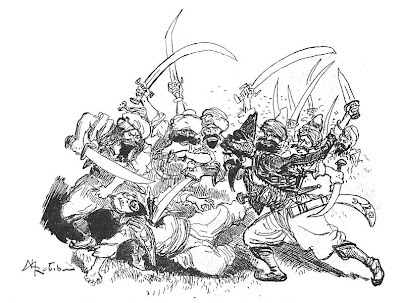
| Albert Robida illustration of the Forty Thieves (from Wikipedia) |
“We were able to bring down Ali Baba. We now have to go after the Forty Thieves.”
Gamal Heshmat, undersecretary of the foreign affairs committee in Egypt’s newly elected parliament, was reacting in Cairo to the disaster that left 79 people dead and hundreds more maimed after a football match between top-tier clubs al-Masry and al-Ahly in Port Said last Wednesday.
He was borrowing from the folk tale in medieval Arabic literature of “Ali Baba and the Forty Thieves” to evoke the overthrow of former president Hosni Mubarak a year ago before pointing the finger of blame for the football catastrophe at Egypt’s ruling generals in the Supreme Council of the Armed Forces (SCAF).
As the print and electronic media continue to show images and video clips of those fatally stabbed, bludgeoned or crushed to death and injured in the Port Said violence, the focus now is on holding SCAF and the Central Security Forces (CSF) to account.
The worst disaster in Egypt’s football history on February 1 has not stopped reverberating in Suez and Cairo street battles, leaving four people dead and more than a thousand injured by this writing today.
In an extraordinary session of Parliament on Thursday, several legislators -- including Amr Hamzawy, Mostafa El-Naggar, Mohamed Abu Hamed and Abu Ezz El-Hariri – accused SCAF of being responsible for the violence, demanding that it hand over power to a civilian authority as soon as possible.
Some MPs echoed the sentiments of protesters by demanding the end of military rule, either by holding presidential elections earlier than the scheduled date of June 2012, or by the appointment of a national salvation government to assume power until a civilian president is elected.
"There is a political crisis because SCAF has lost its legitimacy, which it originally gained on February 11 by the power of the people," said liberal MP Hamzawy during the session. "The main reason why SCAF assumed power was to end the bloodshed [during the revolution] and that hasn't happened yet."
The Moslem Brotherhood’s Freedom and Justice Party, which dominates parliament, detected "invisible planning" behind "this unjustified massacre" in an online statement. But its most prominent representative, Essam al-Erian, said the ruling military and police were complicit. Their aim, he believed, was to show the need to maintain restrictive emergency laws.
Most of the dead at Port Said stadium were al-Ahly supporters. Hardcore fans - known as "Ultras" - have accused SCAF and SCF of allowing the killings to happen.
They say the authorities wanted revenge because the Ultras were among those battling army and police forces during last year's revolution that toppled Mubarak.
Ahram Online has a very informative news feature (and a series of 10 videos) on Egyptian football’s Ultras that are now strongly involved in the country’s heated domestic affairs.
Capitalizing on their physical and organizational capabilities, the flamboyant youth Ultras have featured prominently in recurring confrontations with security forces, and also took part in protests — though not all — throughout the year 2011.
But much as their out-of-stadium appearances gave momentum to events that politically impacted Egypt over the past few months, the motives of the Ultras as a group can barely be deemed political…
During the 18-day revolt last year, Ultras members decided to hit the streets as individuals. However, they became noticed as a group.
Particularly, Ultras Ahlawy and Zamalek’s White Knights soldiered on in Tahrir Square in the face of brutal attacks from the notorious CSF and hired thugs who assaulted and killed protesters in the infamous Battle of the Camel.
Much to their pride and in most battles, members of the fanatic fan bases vanquished the deposed regime’s police personnel and thugs, who eventually failed to nip the uprising in the bud...
At the time, bringing about political upheaval was not really what enthused the Ultras. Rather, the impulse was to lock horns with their archenemies, the police, to avenge abuses they had previously suffered under Mubarak’s security apparatus.
The same urge has ever since remained their primary motive to join political rallies…
On the “Friday of Correcting the Path” on September 9, eight months after the revolution, Ultras Ahlawy and the White Knights made their most sturdy and sensational return to Tahrir Square, the focal point of the January uprising.
On that day, other protesters called for the fulfillment of many demands, such as retribution against those who killed peaceful demonstrators during the revolution and the end of military trials for civilians. The Ultras groups, on the other hand, were there for a dispute with the Interior Ministry.
Their main demand was the release of their cohorts who were arrested three days earlier following a brawl that had erupted with the CSF after the final whistle of an Ahly cup match.
That post-match scuffle reportedly took place when the CSF assaulted Ahly’s Ultras in the stands and arrested some of them, apparently because they cursed Mubarak and former Interior Minister Habib el-Adly in the dying minutes of the game.
While protesting the incident, the Ultras vociferously chanted again against the infamous pair throughout Tahrir and all the way to the nearby Ministry of Interior headquarters…
“All demonstrators always welcome the Ultras members in Tahrir Square,” Ahmed Ezzat, general coordinator of the Popular Committees for Protecting the Revolution, told Ahram Online. “They are highly organized and are not looking for any media attention,” he added. “They have the tendency to struggle in hard times; they are perceived to be comrades in the project of the revolution and have robustly supported the revolutionaries all along.”
***
The morning after the Massacre at Port Said, renowned journalist and author Dima Khatib, contributed an op-ed piece for Counterfire on the prominent role played by the “Ultras” in the Egyptian revolution and speculation of regime complicity in the crowd violence at the Port Said match.
Do you remember this (video)?
Let me refresh your memory. It was on the 2 February 2011, one year ago. Thugs on camels, horses and donkeys, which came all the way from the Pyramids, about 17 kilometers away, attacked Tahrir Square. These clashes that lasted for hours and hours, being watched live on TV all over the world, came to be known as the Camel Battle. It was an unforgettable day in Egypt's 18 days of protests that ended up with toppling Hosni Mubarak on 11 February 2011.
 |
| The pitch invasion in Port Said (photo from albawaba.com) |
Now look at this (Port Said video dated 1 February 2012).
So one year later, at a football stadium in the city of Port Said, chaos breaks after a football match and somehow violence ends up with a death toll of almost 80 people and 300 more injured! Now going back to that famous Camel Battle a year ago, anyone who was there that day in Tahrir would tell you that the Ultras showed amazing bravery in standing up to the thugs and protecting the protesters from them. Yes. I am talking about football Ultras who usually spend their time and energy cheering and chanting for football teams. In fact Egypt's Ultras have played a very important role in the Revolution, not just on 2 February. They were there from day 1 (25 January 2011) chanting, leading and protecting the protesters. I did not know about them until I went to Egypt after Mubarak's fall. It was on 19 June 2011 that I first met an Ultra. It was on 19 June 2011 that I first heard an anti-SCAF slogan too, chanted by the Ultra.
It was outside the Military Prosecution's Office. A very small group of activists were gathered while journalist and activist Rasha Azab was being questioned inside. Civilians like Rasha were being tried, in the thousands, in military courts. The Ultra was chanting: Down with the Military Rule. I was impressed with his energy and internal force, especially in the heat of midday. I was melting in the sun while he never stopped chanting for the whole time that I was there. Hardly anyone back then dared chant against the military, or even dared have bad thoughts about the military. The military was the one that "saved the day," "saved the people from Mubarak," "safeguarded the revolution," etc. The Army of Egypt was sacred in the heads of Egyptians.
By early July many more were chanting against the military rule and were camped in Tahrir Square. Ultras were there too. One of them got me a tent to rest in on the first night while I was doing a Night in Tahrir story for Aljazeera about the sit-in. He stood outside the tent to make sure nobody would harm or bother me. Many female protesters told me they felt safer when Ultras were around because they were brave and were "real men.”
Now back to the present. So many Ultras are dead. Surprisingly -- or maybe not surprisingly -- from al-Ahly football club. Al-Ahly Ultras have been among the most vocal and most active revolutionaries. As the news travelled around the world about those Ultras being killed and injured, many probably thought: oh this was just another hooligans’ fight!
But in Egypt conspiracy theories and accusations grew louder and louder on TV stations and social media. Let's not forget that Egyptians have had quite an eventful week since 25 January 2012 when more people than ever before turned up at Tahrir Square. That was followed by a major bank robbery, clashes between protesters and Muslim Brotherhood supporters outside parliament, continued sit-in outside State TV, etc.
In the beginning of this video you can see clearly how security forces stood by watching while violence was breaking at the stadium. Such footage coupled with countless accounts by witnesses with details of how things turned ugly only came to emphasize people's doubts that the ultras may have been targeted. Whether or not that is true, the damage is already done. As the train from Port Said arrived at Cairo Station after 3 a.m., carrying some of the Ultras, including injured ones, their family members and friends were waiting to see who would come out of the train, alive. Some did come out, safe and sound. Others came out injured. But some did not make it! It was a very emotional moment. And thousands were gathered at the station.
The chanting was becoming louder and clearer:
"Either we get their rights, or we die like them,"
"Down with the Military Rule," "The People Want to Execute the Field Marshall."
 |
| Minister Ghazi el-Aridi |
Ambulances took the injured to hospitals while the Ultras marched on to Tahrir Square, a square they know very well, a square where they have survived many battles before and are ready for any new ones to come.
***
Lebanese MP and government minister Ghazi el-Aridi wonders in a write-up on Egypt for today’s edition of the UAE daily al-Itihad whether we are now watching the fire and brimstone of the revolution there or the revolution burning down. I suspect the former, at least until a new civilian president is duly elected later this year to succeed Mubarak.


