Pages

Showing posts with label Ghassan Hitto. Show all posts

Friday, 29 March 2013

Hollande tucks his tail on arming Syria rebels


French President François Hollande has just eaten his words on arming the Syrian opposition.
Hollande and Syrian coalition leader M. al-Khatib
He said overnight he was unsure if weapons supplied to opposition rebels would not fall into the hands of jihadists.
At the European Union summit in Brussels two weeks ago, Hollande and British Prime Minister David Cameron were both pressing for the relaxation of an arms embargo on Syria so that arms can flow to outgunned rebels fighting regime forces loyal to Syrian President Bashar al-Assad.
The embargo expires on June 1 and both leaders said it should be allowed to lapse.
Speaking in Brussels on March 15, the French president said he had received guarantees from the Syrian opposition that any future arms delivered to them will end up in the right hands.
“In terms of delivering weapons … to have the best answer the opposition must give all necessary guarantees. It's because we have been given those that we can envisage the lifting of the embargo. We have the certainty on the use of these weapons,” he said two weeks ago.
But Hollande backpedaled in his Thursday night interview on France 2 television, telling anchorman David Pujadas: “There is today an embargo, and we respect it. The Russians violate the embargo, and that’s a problem.
“In the past two years, almost 100,000 people were killed in Syria – 100,000. There’s a radicalizing civil war and jihadists are seizing the opportunity to batter Bashar and accumulate credit points for the future.
“No arms can be delivered when the embargo lapses, which is end-May, if we cannot ascertain that such weapons will be used by legitimate (regime) opponents only and held back from any terrorist enterprise.
“For the moment, we don’t have that guarantee. We won’t do it (deliver weapons) so long as there is no certainty the opposition controls the situation.”
Muhammad Ballout, writing today for the pro-Assad Beirut daily as-Safir, says Hollande’s remarks last night are “light years away” from his statement two weeks before in Brussels.
Ballout attributes the French president’s change of heart on arming the Syrian opposition to news that many weapons supplied to rebels in Libya have since turned up in the fighting in Mali.
Another reason cited by Ballout is a report in the French satirical weekly Le Canard enchaîné quoting French Minister Laurent Fabius as telling a council of ministers meeting, “We have to be extra cautious before arming the Syrian opposition because (the head of Syria’s interim government) Ghassan Hitto is close to the Muslim Brotherhood.”
So it looks like Hollande subscribing to Barack Obama’s “paralyzing caution” on Syria.
Fouad Ajami, a senior fellow at Stanford University’s Hoover Institution and author of “The Syrian Rebellion” and other books, yesterday described “How Obama is Failing Syria” in a think piece for Bloomberg, writing in part:
In the matter of the Syrian rebellion, the U.S. hasn’t even “led from behind.” The Obama administration has pioneered a new role for a great power: We are now the traffic controllers, directing the flow of weapons to the rebels.
The money isn’t ours; it is Qatari and Saudi and Libyan. The planes hauling the weapons are Jordanian, Qatari and Saudi. And Syria’s neighbors, principally Jordan, Turkey and Lebanon, run the risks.
Our officials have opinions on Syria, but no one in the Greater Middle East can divine them. We want Bashar al-Assad gone -- our president said so in August 2011 -- a full five months into a brutal war. Then again, through winks and nods, we suggest that the alternative to Assad might be worse than his despotism.
No sooner do we make one definitive statement against the dictator than we hedge it with an invitation to both the dictatorship and the opposition to come to the negotiating table. Great crimes are committed by the Syrian regime, but we are full of worries about the jihadists who have converged on that country. For American officials, the lengths of the fighters’ beards, one Syrian opposition leader lamented, are more important than the massacres.
Barack Obama is a cool, cerebral man. It is his defining image. History won’t rush him or force his hand. If George W. Bush was the “decider,” his successor is the questioner who “wrestles” with decisions…

Tuesday, 26 March 2013

Khatib: I asked Kerry for Patriots to shield N. Syria

From top, Qatar's emir, Khatib leading the opposition delegation, and seated in Syria's chair 

Talking today from Bashar al-Assad’s seat at the Arab summit in Doha, Syrian opposition leader Moaz al-Khatib said he asked Secretary of State John Kerry for U.S. forces “not to fight but to defend northern Syria” with Patriot surface-to-air missiles.
Kerry “promised to consider the matter,” Khatib said without elaborating.
Qatar's emir, Sheikh Hamad bin Khalifa Al Thani, opened the two-day summit by naming Khatib and Interim Prime Minister Ghassan Hitto to lead their combined team to Syria’s assigned seats at the conference.
Khatib went in front and sat in what would have been Syrian President Assad’s chair before addressing the heads of state in the Syrian people’s name.
His address came within an hour or so of a stirring opening speech by Sheikh Hamad in which he pledged to contribute $250 million to a US$1 billion fund for the preservation of (East) Jerusalem as a capital for the future Palestinian state.
The Qatari head of state also proposed an Arab mini-summit in Cairo for the sole purpose of spawning a Palestinian reconciliation between Gaza and the West Bank.
On Syria specifically, Sheikh Hamad said:
We welcome the participation of the Syrian National Coalition of Revolutionary and Opposition Forces and the Syrian Interim Government in our summit.
They are undoubtedly worthy of this representation after earning popular legitimacy at home and wide support abroad, and for the reason that they have assumed a historic role in leading the revolution and preparing to build a New Syria.
Grave and tragic conditions in sisterly Syria have taken a catastrophic turn over the past two years, leading to indescribable tragedies and crimes. Holding one’s tongue about these and about the suffering of the Syrian people in Syria and of the refugees in host countries is in itself a crime.
From the outset, we in the State of Qatar built our position on a set of constants:
-- The immediate cessation of killings and violence against civilians the safeguarding of sisterly Syria’s territorial integrity and popular unity
-- Fulfillment of the will of the Syrian people on the transfer of the power
-- Support Arab and international efforts and political solutions that achieve the Syrian people’s willpower and legitimate aspirations.
(…)
It is unfortunate the Syrian regime chose to enter into a military confrontation with its people, turning down all appeals for serious reform and all Arab political initiatives until the catastrophe reached the stage where the much-loved Syrian people would accept nothing less than a peaceful transition of power, as endorsed by the Arab League resolution dated July 22, 2012.
History will attest as to who stood by the Syrian people in their ordeal and who let them down.
We reiterate our call on the UN Security Council to uphold rights and justice, and pass a resolution ordering an immediate cessation of the bloodshed in Syria and bringing to international justice those responsible for the crimes committed against its people.
We renew our commitment to keep providing humanitarian assistance to the Syrian people, and urge all countries of the world to do so.
We underscore the importance of convening an international conference under UN auspices for the reconstruction of Syria right after the transfer of power as willed by the Syrian people.
I find it important to repeat that we are in favor of a political solution that spares peoples’ blood and lives, presuming that a solution does not put the clock back.
I see the great Syria rising from the rubble soon to rebuild its glory.
Speaking about half-an-hour later, Khatib told the summit:
  • Ours started as a peaceful revolution, but it was met by a heartless man’s hellfire... Syrians are the only people on earth whose breadlines are bombed by warplanes.
  • The Syrian people cannot coexist with the Assad mafia.
  • Whereas we welcome a peace settlement, the regime rejects any solution to the Syria crisis. I suggested talking to Syrian regime representatives in return for the release of prisoners, but the regime shot down the offer.
  • The Syrian people initiated their revolution. They alone will determine its course.
  • Does it take years to recognize our people’s right to self-defense?
  • Occupying Syria’s seat (at the summit) is part of the recovery of the Syrian people’s legitimate rights. We also demand regaining Syria’s seat at the United Nations and other international organizations and the repossession of Syrian (regime’s frozen) assets.
  • Interim Prime Minister Hitto has our full confidence… We also plan to transform the Syrian National Coalition into an all-inclusive National Congress.
  • The Syrian revolution is being undermined on three pretenses: minorities, terrorism and fear of the unknown.
  • The pretense of minorities does not hold water. You need to ask the Lebanese about how the Syrian regime divided all Lebanese sects to rule Lebanon (for 30 years). And who killed Ghazi Kanaan (Syria’s long-time Alawite security chief in Lebanon)? Haven’t Syrian Alawites just concluded a two-day conference in Cairo, which accused the regime of working on turning sectarian zealotry into bloodshed?
  • Regarding the pretense of terrorists being in rebel ranks, what do you call the Russians, Iranians and Hezbollah men fighting in regime ranks? And what about the regime’s two-year reign of terror?
  • A propos fears as to who rules Syria after regime change, my answer is that Syrians alone will decide who rules them and how. It is no one else’s decision.
  • The United States should play a bigger role in helping stop the bloodletting in Syria. I asked Mr. Kerry to extend the Patriots’ umbrella to cover the Syrian north and he promised to consider the matter. We are still waiting for a NATO decision to protect people's lives -- not to fight, but to protect lives.

Wednesday, 20 March 2013

Hitto election unsettles Syrian opposition coalition

SNA deputy leader Suhair Atassi

Key members of the Syrian National Coalition (SNA) -- including deputy leader Suhair Atassi -- have suspended their membership of the opposition umbrella group, a day after the election of Ghassan Hitto as opposition prime minister (see yesterday's post).
Joining Atassi in the protest move are prominent activists and opposition campaigners Dr. Walid al-Bunni and Kamal al-Labwani.
Bunni and Labwani walked out of the SNA meeting in Istanbul prior to Hitto’s election by 35 votes of 48 ballots cast.
Atassi, who is SNA leader Moaz al-Khatib’s deputy, wrote on her Facebook page a while ago: “I am the one who insisted on having a clause in the bylaws banning any SNA member from assuming a position in the interim government. Let it be known I was asked to resign from the SNA to be part of the government and I refused. I said we couldn’t just flout the rules we set… The revolution deserves better than this…”
She was saying Hitto is within, not outwith, the SNA, which broke the rule.
Al Mayadeen TV, which speaks for the axis of Iran, the Syrian regime and Hezbollah, quoted Dr. Bunni as saying, “Hitto was not elected but appointed to head the interim government.”
AFP later quoted Dr. Bunni as saying, "We Coalition members weren't elected to represent the Syrians. So the only persons Hitto represents are the 35 Coalition members who voted for him. This government is a gift to Bashar al-Assad's regime.
"The key issue is the timing and way in which the voting took place. The Coalition pushed for a majority in a group that was not elected.
"Each of us had different reasons for freezing our membership. We will release a statement that represents us all in the coming days.”
Speculation is rife that other SNA members might follow in Atassi, Bunni and Labwani’s suit.

Tuesday, 19 March 2013

Syria’s interim PM lists his government priorities


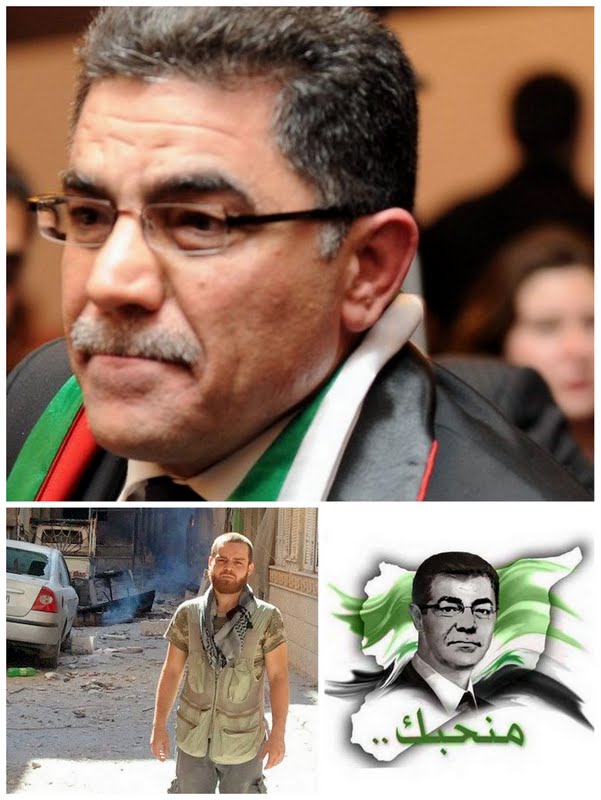
Clockwise from top: Ghassan Hitto, an illustration of kudos, and his son Obaida in Deir Ezzor

Hours after his election as the first prime minister of an interim Syrian government, Ghassan Hitto went on air to address the beleaguered Syria people, saying his administration:
  • Firmly and unequivocally rules out dialogue with the Assad regime.
  • Has “one principal target, which is to bring down the regime by all means and build the New Syria.”
  • Shall kick-start its work from “inside the liberated areas’
  • Shall cooperate closely with the Free Syrian Army (FSA), Higher Military Council and revolutionary forces and endeavor to secure them the military support they need. Together they shall strive to safeguard strategic sites and assets, protect state institutions and take full control of border crossings
  • Shall demand that all humanitarian aid for Syria be channeled through border crossings it controls
  • Shall urge the internally displaced persons (IDPs) to return to their homes in the areas under its jurisdiction
  • Shall uphold all human rights, freedoms and civil liberties and formally foreswear racial, religious, sectarian, gender and ethnic discrimination…
  • Shall invite the international community to extend all assistance possible to the Syrian people
  • Shall request the 130-odd countries that recognized the Syrian National Coalition of Revolutionary and Opposition Forces as the sole legitimate representative of the Syrian people to formally recognize the Interim Government as the legitimate representative of revolutionary Syria
  • Shall demand that all Syrian regime assets frozen or seized by the international community be remitted to the Syrian people through their legitimate representatives
  • Appreciates the political, material and moral aid already extended to the Syrian revolution by such countries as Saudi Arabia, Qatar, the United Arab Emirates, Turkey, France, the United Kingdom, Italy and the United States.

Information technology executive Ghassan Hitto is a naturalized Syrian-born American citizen of Kurdish origin.
He is a 1963 native of Damascus who moved to the United States in 1983.
Last November, the 50-year-old relocated from Wayne in northeast Texas to Turkey to help co-ordinate aid to rebel-held areas.
Hitto, a board member of the Syrian American Council, was already involved in humanitarian aid work stateside, establishing the Shaam Relief Foundation in 2011, and helping organize fundraisers, including a "Walk for Children of Syria Day."
Hitto received 35 votes of 48 ballots cast overnight by members of the opposition Syrian National Coalition, eclipsing other nominees, including Osama Kadi, who I wrongly thought (in an earlier post) would be the man to beat at the meeting in Istanbul.
“A near consensus emerged on Hitto. He is a practical man with management experience and is open to debate. He promised to consult widely before naming ministers and only appoint those with a long experience,” Mohammad Qaddah, the coalition’s representative from Deraa, told Reuters.
Hitto’s first task will be to form his interim government, which will oversee the areas captured from government forces loyal to President Bashar al-Assad.
He earned a bachelor’s degree in mathematics and computer sciences from Indiana's Purdue University in 1989, and a master’s in business administration from Indiana Wesleyan University in 1994.
He is a founding member of the Muslim Legal Fund of America, a U.S. public cause charity established in 2001 to support legal cases impacting civil rights and liberties in America.
Hitto and his wife, Suzanne, an American schoolteacher, have four children, including Obaida, 25, all born in the United States.
Obaida a former high school football player, deferred his plans for law school and sneaked into Syria last year to assist the rebels by making videos and spreading information on the Internet to help their cause.
“Eighty-five percent of the civilian population has left the city,” Obaida said in a Skype interview with The New York Times last September from Deir Ezzor, where he was later injured by mortar shrapnel. “If people only saw what was really happening to the people here they might do the same thing I did.”